Nama J2 vs Nama J3: Is the Upgrade Worth It? (November 2026)
In the Nama J2 vs J3 choice, pick the J3 for small kitchens and frequent moves or the J2 for a permanent counter spot and its higher motor rating. Both offer self-feeding hoppers, so changing models for that feature alone makes little sense.
On this page (11 sections)
- Nama J2 vs J3: which fits your routine?
- Will either Nama fit under your cabinets?
- Which Nama holds more produce?
- Does the J2's stronger motor make better juice?
- Who should buy the J2, and who should skip it?
- Who should buy the J3, and who should skip it?
- What comes with the juicers, and how should you set up?
- How should you load fruit, vegetables and greens?
- How can you keep cleanup manageable?
- What mistakes should you avoid before ordering?
- Nama J2 vs J3: make the final choice
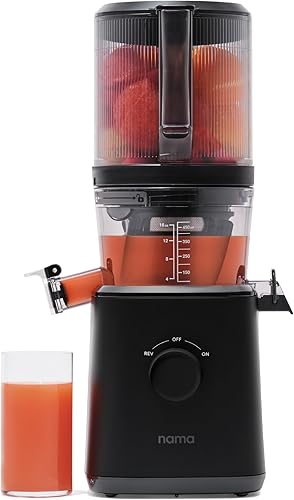
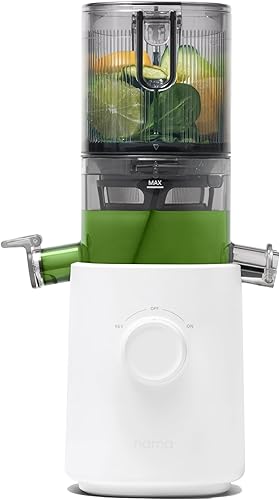
In the Nama J2 vs J3 choice, buy the J3 for a smaller kitchen or frequent moves, and consider the J2 for a permanent counter setup and its higher motor rating. The J3's compact body is a practical difference; a higher model number doesn't make it an upgrade for every buyer.
Both use self-feeding hoppers, so you can load prepared ingredients instead of feeding each piece separately. Your choice should center on where the machine will live, how you'll use it and whether you'll keep up with cleaning.
Nama J2 vs J3: which fits your routine?
The J3 is the stronger fit when space limits your choice; the J2 suits buyers who can give a larger machine a dedicated spot. Start with your daily routine rather than treating motor power as the deciding factor.
A juicer that stays on the counter removes the need to lift it out before breakfast. That makes the J2 a reasonable choice for a kitchen with a fixed juicing area, although the J3 can stay out too.
In a shared kitchen, the machine may need to move whenever someone cooks. The J3 makes more sense there because its smaller body leaves more room for other tasks and is lighter to put away.
Think through one full session: bring out the machine, prepare produce, collect juice, empty pulp, wash parts and put everything back. The best fit is the model you can accommodate through that whole sequence.
Is switching from the Nama J3 to the J2 worthwhile?
Keep the J3 if it already fits your recipes and routine. Moving to the J2 gives you a higher motor rating, but it doesn't add self-feeding or establish better juice yield.
Consider a switch only when you can name a specific need the replacement will meet. Wanting a smaller machine is a clear reason to move toward the J3; wanting more juice from each ingredient needs stronger evidence than wattage.
For a first juicer, choose around your kitchen rather than a possible future upgrade. Our cold press juicer buying guide explains the other features worth weighing before you settle on a model.
Will either Nama fit under your cabinets?
The J3 needs less space in every dimension, but both need room beyond their closed measurements. Allow space to open the hopper, remove the assembly and position the juice and pulp containers.
| Detail | Nama J2 | Nama J3 |
|---|---|---|
| Dimensions, D x W x H | 9 x 9.8 x 17.7 in | 6.5 x 8.9 x 15.4 in |
| Weight | 12.1 lb | 9.7 lb |
| Motor rating | 200 W | 130 W |
| Speed | 50 RPM | 50 RPM |
Use the measurements to mark out each machine's footprint with paper or tape. Add space around that outline for containers, a bowl of prepared produce and your hands.
Cabinet clearance matters most if you plan to leave the juicer beneath an upper cabinet. A body that fits when closed can still be awkward to load, so check whether you can move it forward comfortably.
Also measure the storage shelf if the juicer will live in a cupboard. Avoid a setup that requires lifting the assembled machine overhead or reaching past other appliances to retrieve loose parts.
Which Nama holds more produce?
The capacity figures don't give a direct hopper-size comparison. The J2 has a capacity figure of 1.9 pounds, while the J3 has a figure of 15 fluid ounces; one measures weight and the other volume.
Don't convert the J2 figure into fluid ounces and use it to rank the machines. Different ingredients pack differently, and neither number establishes a matching usable produce volume.
Nama describes both hoppers as accepting a whole recipe at once. Read that as a feeding convenience within the machine's limits, not permission to squeeze any recipe into one load.
If your main goal is making several servings, confirm usable hopper space and loading guidance with Nama before ordering. Also consider whether you have enough containers, refrigerator room and time to clean after that session.
For most buyers, a repeatable recipe is more useful than the largest possible load. Start with a manageable amount, note the result and adjust the next batch without packing the hopper tightly.
Does the J2's stronger motor make better juice?
Motor wattage alone doesn't guarantee juice quality, yield or processing time. Both machines use a masticating design and share the same slow pressing speed.
The J2's higher rating may appeal if motor specification is a firm buying priority. It isn't a sound reason by itself to expect drier pulp, clearer juice or faster results from a particular recipe.
Produce choice and preparation also affect the juicing process. Soft fruit, firm vegetables and fibrous greens present different textures, so a single electrical specification can't describe the whole experience.
Choose the size you can use comfortably, then follow the preparation instructions for your ingredients. Our guide to how a cold press juicer works explains what the auger and strainer do during extraction.
Who should buy the J2, and who should skip it?
Buy the J2 if you have a dedicated counter spot and prefer its higher motor specification. Its included pusher and juice-container lid are also useful distinctions if those accessories matter to your routine.
A fixed setup lets you keep the machine near your produce-prep area and sink. Store its removable parts together so you don't have to search for a strainer or container before each session.
Skip the J2 if its height creates a cabinet problem or its weight makes daily setup a chore. Buying the larger body won't help if it ends up stored somewhere inconvenient.
Also skip an upgrade based only on the hope of larger batches or improved extraction. Those outcomes aren't established by the size and power differences here.
For a closer look at its features and fit, read our Nama J2 review. Use that alongside your own counter measurements rather than treating the larger machine as the automatic default.
Who should buy the J3, and who should skip it?
Buy the J3 if the juicer must share counter space or move into storage after use. It keeps the self-feeding approach in a body designed for smaller kitchens.
That suits an apartment kitchen, a crowded prep area or a household that regularly clears the counter. Its lower weight is also helpful when moving it between suitable workspaces.
Nama describes the J3 as portable, but it remains a corded appliance. It requires 120 V power, so check the destination's electrical supply before planning travel with it.
Pack the containers and removable parts as carefully as the base. A smaller machine still needs a complete kit, a stable work surface and access to washing facilities.
Skip the J3 if your intended location lacks suitable power or you need a cordless machine. If your priority is a verified batch size, settle that question before choosing either model.
What comes with the juicers, and how should you set up?
Both include the core juicing assembly, juice and pulp containers, 2 strainers and a cleaning brush. The J2 also includes a pusher and juice-container lid, while the J3 includes a recipe book.
The shared assembly includes a chamber, hopper, auger and spinning brush, along with a detachable power cord. The spinning brush belongs in the juicing assembly; the separate cleaning brush is for care afterward.
Before the first use, read the assembly and care instructions and wash the removable food-contact parts as directed. Let them dry, then assemble the machine with the power disconnected.
Place the base on a stable, dry surface and position both containers before adding produce. Keep a clear path to the sink so you can move wet parts without crossing your main food-prep area.
Check that the chamber, strainer and hopper sit correctly before starting. If something won't seat, stop and realign it rather than forcing parts together.
How should you load fruit, vegetables and greens?
Prepare produce before filling the hopper, even with self-feeding. Wash ingredients, remove hard pits and follow Nama's directions for peeling, cutting and loading each type of produce.
A whole-recipe hopper reduces one-by-one feeding, but it doesn't remove preparation. Cut ingredients to the approved size and keep pieces loose enough to settle without pressing them down.
For fibrous produce, follow the recommended cutting direction and length. Avoid pushing a tangled bundle of long stems into the hopper just because the lid can close.
Mixed recipes can be easier to manage when you prepare all ingredients first and distribute different textures through the load. Don't force a stalled feed; stop and follow the manual's clearing procedure.
Neither model's self-feeding feature is a reason to leave the appliance running while you leave home. Stay nearby and keep fingers and utensils out of moving parts.
See our guide to cold press juicers for leafy greens for ingredient-specific buying help. Our cold press juicer use guide covers the broader sequence from preparation through cleanup.
How can you keep cleanup manageable?
Clean promptly after juicing and plan for hand washing with either model. Quick-release parts help you take the machine apart, but pulp still needs to come off the food-contact surfaces.
Turn off and unplug the juicer before disassembly. Empty the pulp container, then rinse removable parts before residue dries onto the chamber and strainer.
Use the included cleaning brush gently where pulp collects. Follow Nama's care instructions for washing products and water temperature, and don't assume a dishwasher is suitable.
Keep the motor base out of water and clean its exterior as directed. Let washed parts dry fully before reassembly or storage, especially in a closed cabinet.
The practical space requirement includes a drying area, not just the machine's footprint. A tray near the sink can keep the chamber, containers and smaller parts together while they dry.
Our cold press juicer cleaning guide walks through the care routine. If cleanup effort is your main concern, compare other designs in our easy-to-clean juicer guide.
What mistakes should you avoid before ordering?
Avoid choosing by model number, motor rating or closed-body dimensions alone. Each can distract from the part of ownership most likely to determine whether you use the juicer regularly.
The first mistake is assuming the J3 must replace or outperform the J2 because its number is higher. Here, its clear advantage is a more compact body.
The second is planning around feeding time while ignoring preparation and washing. Self-feeding helps during processing, but you still need to wash produce, handle pulp and clean the removable parts.
The third is buying for an ambitious routine you haven't made room for. Decide where ingredients, clean bottles and drying parts will go before giving the machine a permanent place.
Both carry a 15-year warranty from Nama. Read the warranty terms for coverage and care requirements rather than assuming the length explains every repair situation.
If you're unsure you'll use either often enough, read whether a juicer is worth the time and cleaning. That decision matters more than choosing between two machines that won't fit your habits.
Nama J2 vs J3: make the final choice
Choose the J3 when fitting the juicer into your kitchen is the main challenge. Choose the J2 when you have a dedicated spot, want its higher motor specification and value its included accessories.
If you already own either model and it serves your routine, identify a concrete problem before replacing it. A move to a smaller kitchen is a clear reason to reconsider size; the model name alone isn't.
Before ordering, settle 3 things: where it will stand, where washed parts will dry and how much produce you normally prepare. Confirm usable hopper space if batch size is the deciding factor.
For the Nama J2 vs J3 decision, the better buy is the machine you can set up, use and clean without rearranging your kitchen each time. If neither fits, our juicer brand comparison can help you widen the search.
Frequently asked questions
Is the Nama J3 better than the J2?
The J3 is better for a small kitchen or a routine that involves moving the juicer often. Its smaller, lighter body is the clearest reason to choose it.
The J2 suits a permanent counter setup if you want its higher motor rating, but that rating doesn't guarantee better juice.
What is the main difference between the Nama J2 and J3?
Size, weight and motor rating are the main differences. The J2 measures 9 x 9.8 x 17.7 inches, weighs 12.1 pounds and has a 200 W motor.
The J3 measures 6.5 x 8.9 x 15.4 inches, weighs 9.7 pounds and has a 130 W motor.
Can the Nama J3 juice a whole recipe at once?
Nama describes the J3's self-feeding hopper as able to accept a whole recipe at once, provided it fits within the machine's loading instructions. The J2 offers the same feeding approach.
Prepare ingredients as directed, avoid overfilling and divide a recipe into smaller loads when needed.
Are the Nama J2 and J3 easy to clean?
Both have quick-release parts and include a cleaning brush, which help with taking the machine apart and removing pulp. Both require hand washing.
Empty the pulp, rinse removable parts promptly and clean the strainer before residue dries, then let everything dry fully before putting it away.