6 Best Easy-to-Clean Juicers (November 2026)
The best easy-to-clean juicers include the Ninja NeverClog JC151 for dishwasher users, the TUUMIIST 3-in-1 Juicer for varied recipes, and the Godspeeds Smoothpress 6-Inch for narrow counters.
On this page (7 sections)
- Which easy-to-clean juicer fits your routine?
- Best easy-to-clean juicers by cleanup style
- What should you compare before buying an easy-to-clean juicer?
- How should you set up a juicer for easier daily cleanup?
- How can you make juicer cleanup easier after each batch?
- Which mistakes make an easy-to-clean juicer harder to maintain?
- Which easy-to-clean juicer should you choose?
The Ninja NeverClog JC151 is the best easy-to-clean juicer for most people because all its juice-contact parts are dishwasher safe. Choose the mesh-free Aeitto if scrubbing a screen is the chore you most want to avoid.
The right choice depends on what slows you down: taking the machine apart, brushing pulp from a filter or finding room to wash and dry everything. A large feed opening can save chopping, but it solves a different problem.
For a step-by-step routine, see our guide on how to clean a cold press juicer. If you're deciding whether the cleanup is worth the daily effort, read is a juicer worth the cost, time and cleaning?.
Our picks at a glance
-
1

-
2
-
3

Which easy-to-clean juicer fits your routine?
Choose Ninja for dishwasher cleanup, Aeitto for avoiding mesh screens or SMALLHOO for family batches. TUUMIIST suits varied recipes, Godspeeds fits narrow counters and YPONE offers the lowest stated height here.
ThingsWorthy compared disassembly, filter design, washing guidance and kitchen fit. The order favors clear cleanup benefits, with conflicting care instructions counting against models that leave dishwasher use uncertain.
Decide how you'll wash before comparing hopper size or extra recipes. A machine that suits your sink, dishwasher and drying area is easier to keep in regular use.
| Product | Best for | Cleanup | Feed design | Size | Our score |
|---|---|---|---|---|---|
| Ninja NeverClog JC151 | dishwasher users | Dishwasher-safe juice-contact parts | Chute width not specified | 12.11 x 7.15 x 15.93 in | 8.8 |
| TUUMIIST 3-in-1 Juicer, 6.5-Inch | varied recipes | Quick-release parts; brush included | 6.5 in chute; 100 oz hopper | 7 x 13 x 17 in | 8.2 |
| Godspeeds Smoothpress 6-Inch | narrow counters | Detachable filter rinses under tap | 6 in chute | 6 x 6 x 16 in | 8.1 |
| SMALLHOO 3-in-1 7-Inch Juicer | family batches | Tool-free disassembly; conflicting care guidance | 7 in chute; 120 oz hopper | 13 x 7.5 x 17 in | 7.8 |
| Aeitto 3-in-1 6-Inch Juicer | screen-scrubbing avoiders | Mesh-free chamber rinses under running water | 6 in chute; self-feeding | 8 x 8 x 16.9 in | 7.6 |
| YPONE 2-in-1 5.8-Inch Juicer | low-clearance kitchens | 3 main parts; dual mesh strainers | 5.8 in chute | 5 x 11 x 13 in | 7.3 |
Best easy-to-clean juicers by cleanup style
Buy for the washing routine you'll actually follow after every session. These picks address different chores, so the highest-ranked model isn't automatically the right choice for every kitchen.
Ninja NeverClog JC151: Best for dishwasher users
- Dishwasher-safe juice-contact parts
- Two pulp filters
- Anti-drip lever
A clear choice for daily juice drinkers who use a dishwasher. Two pulp filters offer texture control, and the anti-drip lever helps contain spills when pouring.
Pros
- All juice-contact parts are dishwasher safe
- Choice of Less Pulp or Lots of Pulp
- Anti-drip lever
Cons
- Filters need prompt rinsing to remove pulp
- 24 oz juice jug needs emptying during larger batches
The Ninja NeverClog JC151 suits daily juice drinkers who want the dishwasher to handle the main wash. All juice-contact parts are dishwasher safe, giving it the clearest advantage for that routine.
The two interchangeable filters offer Less Pulp and Lots of Pulp options. Pick the texture you prefer, then rinse the filter you used promptly so wet pulp doesn't dry into its openings.
Its anti-drip lever helps control spills when you pause and pour. That matters if sticky juice around the jug creates as much cleanup as the machine itself.
The 24 oz juice jug works better for smaller sessions than for serving a crowd. Larger batches mean watching the fill level and emptying the jug before continuing.
Choose Ninja if you have dishwasher space and want simple Start/Stop and Reverse controls. Skip it if your main goal is eliminating filter cleaning, or if frequent jug emptying would interrupt your routine.
Leave room beside the body for both collection containers. For assembly and cleaning steps across cold press models, see how to use a cold press juicer.
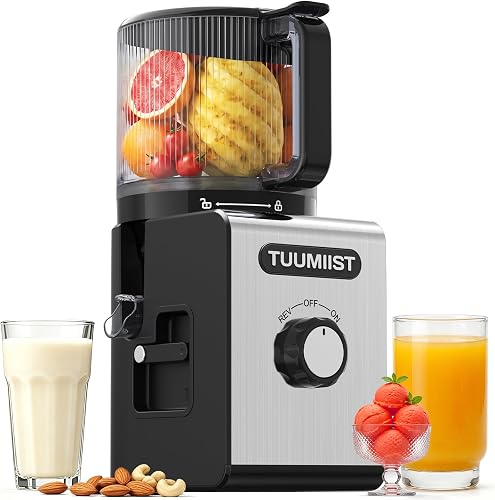
TUUMIIST 3-in-1 Juicer, 6.5-Inch: Best for varied recipes
- One strainer for 3 uses
- Quick-release parts
- 100 oz hopper
One strainer handles juice, nut milk and sorbet, reducing accessory swaps between recipes. Quick-release parts suit buyers who plan to rinse and wash promptly.
Pros
- One strainer for juice, nut milk and sorbet
- Quick-release parts
- Cleaning brush included
Cons
- Conflicting dishwasher and hand-washing instructions
- 17 in height needs overhead clearance
The TUUMIIST 3-in-1 suits households that will regularly make juice, nut milk and sorbet. One strainer handles all three, so you don't need separate strainers for each recipe type.
Its quick-release parts help you get from finished drink to washing without a lengthy teardown. The included brush gives you a way to clear pulp from areas that running water doesn't reach.
A 6.5-inch chute and 100 oz hopper suit recipes you want to load together. Check produce size before feeding, and still remove peels, pits or seeds when preparation calls for it.
The care guidance includes both dishwasher-safe and hand-wash-only directions. Plan on hand washing until the manual for your exact machine identifies which parts, if any, can go in the dishwasher.
Choose TUUMIIST if you value recipe variety and can accommodate its 17-inch height. Skip it if you only make juice and need clear dishwasher guidance above all else.
Before switching between nut milk and fruit recipes, wash the food-contact parts thoroughly. Sharing one strainer reduces accessory storage, but it doesn't remove the need to clean between uses.
Godspeeds Smoothpress 6-Inch: Best for narrow counters
- Detachable toothed filter
- Three-step assembly
- 6 x 6 in footprint
A narrow body suits kitchens with limited counter space. Its removable toothed filter gives you direct access for rinsing and brushing after juicing.
Pros
- Smallest stated footprint here
- Detachable toothed filter
- Cleaning brush included
Cons
- Filter still needs attention after each batch
- 473 ml capacity suits smaller servings
The Godspeeds Smoothpress suits a narrow counter and a wash-by-hand routine. Its detachable toothed filter gives you access to the surface that catches pulp, rather than leaving you to rinse around an assembled chamber.
Godspeeds describes a three-step assembly, and a brush is included for stuck fibers. Keep that brush beside the drying area so filter cleaning becomes part of the same task as washing the other parts.
The body has a 6 x 6-inch footprint, the smallest stated footprint in this group. You'll still need space for its collection cups and clearance above the feed opening.
Its stated capacity is 473 ml, so it makes more sense for smaller servings than for a household expecting one large collection vessel. Check the cup during longer recipes and pause before it fills.
Choose Godspeeds if counter width is your main limit and you're comfortable cleaning a removable filter. Skip it if you specifically want a mesh-free system or a larger collection capacity.
Dishwasher care is supported, but follow the manual's directions for individual components. Keep the base dry and separate from everything going into the sink.
SMALLHOO 3-in-1 7-Inch Juicer: Best for family batches

- Tool-free disassembly
- 120 oz hopper
- Juice, nut milk and sorbet
The large hopper suits households making several servings in one session. Tool-free disassembly helps you move straight from batch preparation to washing.
Pros
- Large hopper for batch preparation
- Tool-free disassembly
- Makes juice, nut milk and sorbet
Cons
- Conflicting dishwasher and hand-washing instructions
- Needs counter and drying space for a larger setup
The SMALLHOO 3-in-1 suits families that make several servings in one session. Its 120 oz hopper and tool-free disassembly support a batch routine with one teardown after the session.
The 7-inch chute reduces cutting for produce that fits. It doesn't remove preparation rules: peel produce and remove pits or seeds as needed before loading.
This model makes juice, nut milk and sorbet. Those extra uses are worthwhile if they'll replace separate preparation tasks in your household, rather than become features you rarely use.
Its washing guidance conflicts: dishwasher-safe parts are described alongside hand-wash-only care. Use hand washing until the manual or SMALLHOO resolves the instructions for your exact machine.
Choose it if several people want juice together and you have room to handle a larger hopper at the sink. Skip it if you usually make one small drink or have a cramped drying area.
Before making sorbet or nut milk, follow the current instructions for thawing fruit or soaking nuts. Those steps differ from feeding fresh produce, so don't treat every ingredient the same way.
Aeitto 3-in-1 6-Inch Juicer: Best for screen-scrubbing avoiders

- Mesh-free system
- Straight-through chamber
- Brush included
Choose this model when cleaning fine mesh is the task you most want to remove. Its mesh-free system handles juice, nut milk and sorbet without extra mesh screens.
Pros
- No mesh screen to scrub
- Straight-through chamber for rinsing
- No mesh-screen swaps between recipes
Cons
- Other food-contact surfaces still need washing
- Dishwasher suitability needs confirmation in the manual
The Aeitto 3-in-1 is the strongest fit when avoiding mesh-screen scrubbing is your main goal. Its mesh-free system uses a straight-through chamber that rinses under running water.
That design directly addresses a common cleanup bottleneck: clearing fibers from small screen holes. You still need to wash the chamber, auger, outlets and other food-contact surfaces after use.
The same system makes juice, nut milk and sorbet without swapping extra mesh screens. An included brush helps with residue in places that need more attention than a rinse.
Its 6-inch chute and self-feeding design suit loading produce with less repeated feeding. Prepare ingredients for the recipe and machine, even when they fit through the opening whole.
Choose Aeitto if filter scrubbing has kept you from using a juicer regularly. Skip it if dishwasher use is essential and you need confirmed care directions before buying.
Allow overhead space beyond its 16.9-inch body height for loading and removal. For different produce types, our cold press juicers guide explains what to compare.
Follow Aeitto's own soaking and thawing instructions for non-juice recipes; preparation times from another brand aren't interchangeable.
YPONE 2-in-1 5.8-Inch Juicer: Best for low-clearance kitchens

- Three main parts
- 13 in height
- Juice and nut milk
The shortest body in this group suits kitchens with limited vertical space. Its three-main-part layout keeps assembly straightforward, but the dual mesh strainers still need careful washing.
Pros
- Shortest stated height here
- Three-main-part layout
- Cleaning brush included
Cons
- Conflicting dishwasher and hand-washing instructions
- Dual mesh strainers require brushing when pulp sticks
The YPONE 2-in-1 suits kitchens where cabinet clearance matters more than removing screen-cleaning work. At 13 inches tall, it has the lowest stated body height in this group.
Its three-main-part layout offers a straightforward assembly routine. That can help if keeping track of components bothers you more than the washing itself.
The trade-off is its dual mesh strainers. You'll need to inspect the mesh for trapped pulp and use the included brush when rinsing leaves fibers behind.
YPONE makes juice and nut milk, and its 5.8-inch feed opening accepts produce that fits. Leave room above the machine for loading and lifting parts off, even if the body fits beneath a cabinet.
Choose it if vertical space is tight and you prefer washing by hand. Skip it if your main aim is avoiding mesh, since a simple parts layout doesn't remove those filter surfaces.
Its care guidance contains both dishwasher and hand-washing directions. Hand wash until the exact component instructions are clear, and avoid assuming that fewer main parts means fewer places for residue to collect.
What should you compare before buying an easy-to-clean juicer?
Compare washing method, filter access and kitchen space before motor power or chute width. Those three details determine whether cleanup fits naturally into your day.
Which is the best easy-to-clean juicer for your washing method?
A dishwasher user should start with clear approval for the food-contact parts. A hand washer should focus on surfaces they can reach, pieces they can hold comfortably and filters they can inspect while rinsing.
Think about timing too. If the dishwasher runs only every other day, you may need to hand wash the juicer parts before your next session anyway.
Check rack space rather than assuming every approved part fits your usual load. A hopper competing with plates and glasses can make machine washing less convenient than expected.
Is a mesh-free design worth choosing?
Choose mesh-free if fine screen holes are your main cleaning problem. It removes that particular surface from the routine, which is more useful than a general promise of easy cleanup.
A detachable filter can still be practical if you don't mind brushing. What matters is being able to reach both sides and check that the openings are clear.
Don't judge cleanliness by the chamber alone. Pulp outlets, grooves and the underside of removable parts also need attention.
Do quick-release or tool-free parts matter?
They matter most when awkward disassembly would make you postpone washing. Easy access lets you remove wet pulp before it dries onto the surfaces.
Part count needs context. Three main parts can still contain detailed surfaces, while a setup with more separate pieces may expose each surface more clearly.
Picture the complete sequence: remove the hopper, separate the food-contact pieces, empty the containers and wash everything used. Choose the arrangement you can manage comfortably beside your sink.
How does chute size affect cleanup?
A wider chute mainly saves produce preparation, not washing. It helps with ingredients that fit, while leaving the auger, chamber and collection containers to clean afterward.
Large hoppers make sense for several servings prepared together. For a single small drink, consider whether handling and drying the larger piece suits your space.
Measure the work area, not just the stored machine. You'll need room for cups, a cutting board, loading access and a towel or rack for drying.
For help balancing these details with your recipes, read how to choose a juicer by chute, auger, pulp and cleaning.
How should you set up a juicer for easier daily cleanup?
Place the juicer where you can prep, pour and wash without moving it repeatedly. Keep a clear route to the sink and enough space for both juice and pulp containers.
Before the first recipe, wash approved removable parts as directed and learn how they align. Assemble everything with the machine unplugged, then check that the chamber and lid lock correctly.
Keep the outlet area visible so you can spot a filling cup or stray drips. A container placed slightly off-center can create an avoidable counter-cleaning job.
Set aside a drying area before you begin. Parts left piled in the sink are harder to inspect and can block the space you need to finish washing.
Prepare the whole recipe before switching on the motor. Wash produce, remove unsuitable pits or peels and cut ingredients as the manual directs.
A wide chute doesn't mean every long or fibrous ingredient should go in uncut. Our guide to putting celery in a juicer covers preparation for a common stringy ingredient.
Keep the supplied pusher and cleaning brush within reach, with the brush stored clean and dry. Use the pusher as directed, and never put fingers or kitchen utensils into the feed opening.
How can you make juicer cleanup easier after each batch?
Remove pulp while it's still wet, then wash every used food-contact part according to the manual. Prompt cleaning prevents residue from becoming a harder brushing job later.
- Switch off the machine, wait for movement to stop and unplug it.
- Empty the pulp container and remove loose scraps into the trash or compost.
- Separate removable parts in the instructed order.
- Rinse away loose pulp, then wash approved parts by hand or dishwasher.
- Inspect filters, grooves and outlets, rinse as needed and leave the pieces apart to dry.
Use the included brush gently on filter openings and narrow passages. Avoid sharp tools that can damage a screen or scratch a food-contact surface.
For hand washing, use the cleaner and water temperature allowed by the manual. Don't assume very hot water, abrasives or a long soak are safe for every component.
Wipe the unplugged base with a suitable damp cloth, keeping water away from electrical areas. Let washed pieces dry fully before putting them into closed storage.
A rinse is useful for removing loose pulp, but it doesn't replace the washing step. This matters after nut milk or sorbet too, even if the parts look less fibrous than they do after vegetable juice.
For more cleaning steps and care advice, see how to clean a cold press juicer. If you're new to slow juicing, our cold press juicer buying guide covers setup, produce prep and other features to weigh.
Which mistakes make an easy-to-clean juicer harder to maintain?
The biggest mistakes are letting pulp dry, feeding too aggressively and guessing at care instructions. Fixing those habits is more useful than choosing a model by motor wattage alone.
Leaving the filter until later
Clean or at least begin the approved washing routine before settling in with your drink. Fibers left in a filter can dry into the openings and require more careful brushing.
Don't leave dirty parts assembled overnight. Separating them promptly exposes residue that can hide around joins and outlets.
Treating a large chute as permission to overfill
Load and feed according to the manual, leaving the machine to process ingredients at its intended pace. Pushing harder isn't a substitute for cutting produce appropriately.
If ingredients stop moving, follow the model's jam-clearing steps. Never reach inside or start taking parts off while the machine is powered.
Choosing by speed or yield claims
Motor wattage, low rotation speed and claimed juice yield don't show how easily you'll reach trapped pulp. For this search, accessible surfaces and clear washing directions are the more useful buying details.
Likewise, don't plan your morning around a promised cleanup time. Your recipe, batch size and washing method determine the actual work.
Applying one washing rule to every part
A dishwasher-safe description doesn't cover the motor base, and mixed care guidance needs resolving before machine washing. Use the instructions for your exact model and component.
Avoid borrowing soaking or frozen-fruit directions from another machine. Different recipe systems can call for different preparation, even when both juicers make nut milk or sorbet.
Which easy-to-clean juicer should you choose?
Choose Ninja if dishwasher cleanup is your priority, Aeitto if you want to remove mesh-screen scrubbing or Godspeeds if your counter is narrow. Those choices address three distinct daily needs.
Pick TUUMIIST if you'll regularly use all three recipe types, SMALLHOO for family-sized loading or YPONE when low cabinet clearance drives the decision. For the models with conflicting care guidance, be ready to hand wash until the directions are resolved.
The best easy-to-clean juicer is the one you can take apart, wash and dry comfortably after every session. Before ordering, measure your working space and decide whether you'll actually use the dishwasher or wash at the sink.
If several models still fit, compare the best cold press juicers roundup to weigh the features that matter beyond cleanup.
Our top 3 picks at a glance
-
1
-
2
-
3
Frequently asked questions
What makes a juicer easy to clean?
Accessible food-contact surfaces, simple disassembly and clear washing instructions make a juicer easier to clean. Dishwasher-safe parts reduce hand washing, while a mesh-free design removes screen scrubbing.
Also consider the space needed to rinse and dry everything, since a large hopper can be awkward beside a small sink.
Are cold press juicers hard to clean?
Cold press juicers need cleaning after every session, but the work varies with their filters, chambers and assembly. A removable filter gives you access to trapped pulp, while a mesh-free chamber avoids fine screen holes.
Rinse promptly, then wash as directed so residue doesn't dry onto the parts.
Can I put juicer parts in the dishwasher?
Put only approved removable parts in the dishwasher, following the manual's rack and cycle instructions. All Ninja NeverClog JC151 juice-contact parts are dishwasher safe.
TUUMIIST, SMALLHOO and YPONE have conflicting care guidance, so hand wash until the instructions for your exact model resolve it.
Never immerse the motor base.
Do mesh-free juicers still need a brush?
Yes, a mesh-free juicer can still need a brush around outlets, grooves and other places where pulp collects. Aeitto includes one alongside its rinse-through chamber.
Removing a mesh screen changes the cleaning task, but you still need to separate, wash, rinse and dry the remaining food-contact parts after use.
How soon should I clean a juicer?
Clean a juicer as soon as practical after each session, before pulp dries onto its surfaces. Switch it off, wait for movement to stop and unplug it before taking it apart.
Empty the pulp, rinse removable parts, then wash them as directed and leave them apart to dry fully.
Does a wide feed chute make cleanup easier?
A wide chute mainly reduces chopping for produce that fits; it doesn't remove the need to wash the chamber, auger and filter. A larger hopper also needs sink and drying space.
Choose feed size for your recipes, then judge cleanup separately by access, washing instructions and the parts you handle.