Nama J2 Cold Press Juicer Review: Worth It? (November 2026)
The Nama J2 suits regular juicers who want to load a recipe together instead of feeding produce piece by piece. Choose it if you have counter space and will hand wash the parts after each session.
On this page (8 sections)
- What does the Nama J2 offer?
- How does the Nama J2 compare with alternatives?
- How much space should you allow for the J2?
- Does self-feeding remove the need to prepare produce?
- How should you choose recipes for leafy greens and other produce?
- Is the Nama J2 easy to clean after daily use?
- Which buying mistakes should you avoid?
- Should you buy the Nama J2 or choose another juicer?
The Nama J2 is a good fit for regular batch juicing if you want to load ingredients together rather than feed them piece by piece. Its strongest appeal is a simpler feeding routine, provided you have room for the machine and will clean it after each use.
Choose it around your actual habits: the recipes you make, where the juicer will sit, and how soon you can wash the parts. A self-feeding hopper saves attention during juicing, but preparation and cleanup still shape the whole job.
What does the Nama J2 offer?
The J2 offers self-feeding cold press juicing for recipes that combine fruits, vegetables and leafy greens. Its hopper holds the ingredients while the machine feeds them into the pressing mechanism.
Nama J2 Hands-Free Juicer: Best for regular batch juicing
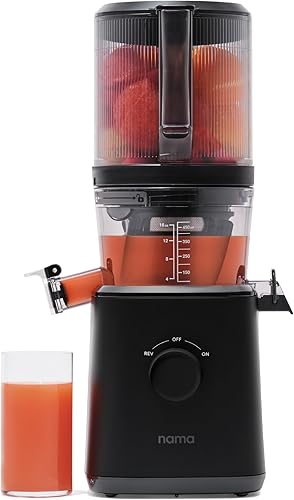
- Self-feeding hopper
- 200 W motor
- 50 RPM
- 15-year warranty
The J2 suits a regular juice routine built around loading several ingredients together. Its self-feeding hopper reduces feeding work, while quick-release parts help with disassembly afterward.
Pros
- Self-feeding hopper for recipe batches
- Processes leafy greens and other produce
- Includes juice and coarse strainers
- NAMA provides a 15-year warranty
Cons
- Needs more storage space than the J3
- Hand wash only
- Extra recipe functions may need separate accessories
The machine comes with a chamber, hopper and lid, auger, spinning brush, juice and pulp containers, juice and coarse strainers, pusher, detachable power cord and cleaning brush. That gives you the core parts for making juice and cleaning up afterward.
The strainer choice is useful if texture matters to you. A finer strainer separates more pulp, while a coarse strainer allows a fuller texture; choose the one that matches your recipe rather than assuming every drink needs the same setup.
Who should buy the Nama J2?
Buy the J2 if you make juice often enough that feeding each ingredient feels like the main interruption. Loading a prepared recipe together makes sense for a morning routine with several ingredients.
It also suits someone who can give the machine a regular counter spot. Leaving a juicer within reach removes the extra step of carrying it out and finding room every time.
Skip it if you expect self-feeding to remove most of the work. You'll still wash produce, remove unsuitable pits or peels, assemble the parts, empty the pulp and wash the juice-contact pieces.
For occasional juice, think through that routine before choosing a larger appliance. A machine that stays in a cupboard because cleanup feels inconvenient won't become useful simply because its hopper feeds itself.
How does the Nama J2 compare with alternatives?
Choose the J2 for regular recipe batches, the J3 for easier storage, the AUTO10 for extended sessions, or the H330 for its texture options and mixed recipes. Counter space and intended use separate these choices more clearly than motor power alone.
| Juicer | Capacity | Size (D x W x H) | Motor or operating detail |
|---|---|---|---|
| Nama J2 Hands-Free Juicer | 1.9 lb | 9 x 9.8 x 17.7 in | 200 W, 50 RPM |
| Kuvings AUTO10 Hands-Free | 3-liter hopper | 10 x 8 x 19 in | 240 W; Kuvings specifies up to 45 minutes continuous operation |
| Hurom H330 Slow Juicer | 2-liter hopper | Confirm assembled dimensions for your space | 50 RPM |
| Nama J3 Compact Juicer | 15 fl oz | 6.5 x 8.9 x 15.4 in | 130 W, 50 RPM |
Capacity figures in pounds, liters and fluid ounces don't form a reliable batch-size ranking. They also don't tell you how much finished juice you'll get, since that changes with the ingredients and their condition.
Kuvings AUTO10: choose it for longer sessions
The AUTO10 makes sense if you prepare several recipes in one session. Its auto-cutting blade and self-feeding hopper support that workflow, and its included juice, smoothie and sorbet screens give you more recipe options out of the box.
Skip it if you mainly make a small drink and must carry the juicer to a cupboard afterward. At 15.5 lb, it is heavier than the J2, and its taller body needs more overhead room.
Its service terms also matter: warranty coverage and replacement parts are available only in the US and Canada. For more alternatives alongside it, see our best cold press juicers.
Hurom H330: choose it for varied textures
The H330 suits a household that wants smooth juice, fuller-textured drinks, nut milk and smoothies from one self-feeding machine. Its fine and coarse strainers let you choose texture, and the motor stops if the hopper lid opens.
Skip it if frozen desserts are the main reason you're buying. Hurom's ice cream strainer is sold separately, so that use needs an extra accessory.
Confirm its assembled footprint before planning a permanent spot. Container placement and room to remove the hopper matter as much as the space under the base.
Nama J3: choose it for limited space
The J3 is the better choice if lifting and storing the machine would otherwise keep you from using it. It weighs 9.7 lb, compared with the J2's 12.1 lb, and takes less space in every dimension.
Skip it if you want to load larger recipes with as little refilling as possible. Its smaller format favors buyers who accept more loading in exchange for easier placement and storage.
The Nama J2 vs J3 comparison helps you decide between those routines. Our cold press vs masticating juicer guide explains the terms you'll see while shopping.
How much space should you allow for the J2?
Allow room for the machine, both containers and assembly, rather than measuring only the base. A spot that fits the juicer tightly under a cabinet may still be awkward for loading or removing the hopper.
Mark out the base area on your counter, then place bowls where the juice and pulp containers would sit. Check that you can reach the controls without crowding the sink or the area where you prepare produce.
Next, think about the washing route. A clear place beside the sink for disassembly and air-drying makes cleanup easier than carrying dripping parts across the kitchen.
If you plan to store the J2, choose a shelf you can reach comfortably. Avoid a setup that requires lifting it over other appliances each time.
Does self-feeding remove the need to prepare produce?
Self-feeding reduces repeated feeding, but produce still needs sensible preparation. Follow NAMA's directions for ingredient size and loading rather than assuming every whole fruit belongs in the hopper.
Wash produce before cutting it, remove hard pits, and discard spoiled portions. Remove peels that are unsuitable for your recipe, and cut anything that won't fit comfortably.
For long, stringy ingredients, follow the manual's cutting guidance. A wide opening doesn't mean fibrous stalks should always go in at their full length.
Arrange a clear work area before starting: prepared produce, an assembled juicer, and containers in position. Keep the machine in view while it runs so you can respond to a blockage or a full container.
Use the supplied pusher only as directed. Never use fingers, cutlery or another kitchen tool to push ingredients toward moving parts.
If you want a step-by-step routine, our guide to using a cold press juicer covers preparation through cleanup.
How should you choose recipes for leafy greens and other produce?
Choose recipes around ingredients you'll use regularly, with leafy greens as one part of the plan. The J2 is designed to process greens, but their juice output will differ from that of water-rich fruits and vegetables.
Start with a short ingredient list so you can adjust flavor without wasting a large batch. Strong greens, citrus and ginger can dominate a drink even when they occupy little hopper space.
Alternate softer ingredients with firmer produce where NAMA's recipe guidance allows. Avoid packing wet leaves into a tight mass, and let the machine process the load without forcing it.
Freshness matters too. Wilted or dried-out produce contains less available moisture, so a juicer cannot make every bag of greens produce the same amount.
Don't choose the J2 on an unmeasured promise of extra yield. Its more useful buying case is that it combines self-feeding with support for the ingredients you want to juice.
Read our guide to cold press juicers for leafy greens for more ingredient advice. For the mechanics behind pressing and pulp separation, see how a cold press juicer works.
Is the Nama J2 easy to clean after daily use?
The J2 offers quick-release parts and a cleaning brush, but daily use still requires hand washing. The best routine is to clean it before the pulp dries.
Empty the pulp container after juicing, then switch off and unplug the machine before taking it apart. Follow NAMA's disassembly order rather than pulling at parts that still feel locked together.
Rinse removable juice-contact parts promptly, then wash them with the cleaner and water temperature allowed in the care instructions. Brush the strainer gently, paying attention to small openings and pulp caught around edges.
Keep the motor base out of water. Wipe it as directed, and let washed parts dry fully before storing them.
A water rinse alone doesn't replace washing after use. It may clear loose pulp, but residue can remain around the strainer, seals and outlets.
Leave enough time for this step when deciding whether morning juicing fits your schedule. Our cold press juicer cleaning guide explains how to handle stuck pulp without turning cleanup into a long job.
Which buying mistakes should you avoid?
Avoid choosing by motor watts, hopper claims or warranty length alone. None of those tells you whether the machine fits your recipe, kitchen and washing routine.
- Treating motor power as a yield score: a higher wattage doesn't mean one machine will produce more juice from the same ingredients.
- Confusing input capacity with juice output: the amount loaded isn't the amount collected, and different capacity units aren't directly comparable.
- Buying for recipes you rarely make: extra screens matter only if you'll use them and wash the additional parts.
- Ignoring accessory requirements: don't assume a recipe named among possible uses means every needed attachment is included.
- Forgetting container space: a clear footprint under the base isn't enough if juice and pulp have nowhere to collect.
NAMA backs the J2 with a 15-year warranty. Check coverage, care requirements and the service process before buying, especially if long-term support is part of your decision.
Build a short checklist around your most common recipe and available space. Our guide to choosing a juicer helps turn those needs into a focused comparison.
Should you buy the Nama J2 or choose another juicer?
Buy the Nama J2 for a regular multi-ingredient juice routine when you can keep it accessible and wash it after each session. Its self-feeding design is most useful when it removes a task you already find repetitive.
Choose the J3 if storage or lifting would be the bigger barrier. Choose the AUTO10 for extended sessions and included dessert screens, or the H330 for mixed recipes with a choice of juice texture.
Before deciding, walk through one complete session in your kitchen: prepare produce, load the hopper, collect juice, empty pulp, wash parts and leave them to dry. Choose the machine that fits that whole routine.
For a broader look at support, features and model choices, use our juicer brands guide.
Frequently asked questions
Is the Nama J2 a cold press juicer?
Yes, the Nama J2 is a masticating cold press juicer that presses produce with an auger. Its self-feeding hopper lets you load ingredients together rather than add each piece by hand, making it a useful choice for regular multi-ingredient juice recipes.
How much produce fits in the Nama J2?
NAMA gives the J2 a 1.9 lb capacity, but the amount that fits depends on the size and shape of your ingredients. Follow the hopper's loading guidance and prepare produce as instructed; don't use the capacity figure as a promise of finished juice volume.
Is the Nama J2 easy to clean?
The J2 has quick-release parts and a cleaning brush, but its removable parts require hand washing. Empty the pulp and rinse juice-contact parts promptly, then wash them according to NAMA's instructions.
Pay particular attention to the strainer, where pulp can dry into the small openings.
How does the Nama J2 compare with the J3?
The J3 is smaller and lighter, so it is the better fit for limited counter space or frequent storage. The J2 suits buyers who can leave a larger machine out for regular recipe batches.
Both use self-feeding hoppers, so the J3 retains that main convenience.