Cold Press vs Masticating Juicer: Is There a Difference? (November 2026)
The cold press juicer vs masticating juicer comparison usually describes the same slow, auger-based machine. Choose by feeding method, pulp control, cleanup and kitchen space rather than treating the names as separate types.
On this page (8 sections)
- Is there a cold press juicer vs masticating juicer difference?
- Which juicer fits the way you prepare produce?
- Does the name tell you how much pulp you'll get?
- Which style is easier to clean?
- What should you measure before choosing a juicer?
- How should you set up and feed a slow juicer?
- Which common mistakes make the buying decision harder?
- Which one should you choose?
The cold press juicer vs masticating juicer choice usually involves the same type of machine: a slow auger that crushes and presses produce. Your useful choice is between feeding methods, pulp options, cleanup routines and counter layouts.
“Cold press” describes the extraction approach, while “masticating” describes the crushing action. Neither term tells you whether you'll need to feed ingredients throughout a recipe or wash every removable part by hand.
Our guide to what cold press means explains the label, and how a cold press juicer works walks through the mechanism. Start with those basics, then choose the machine that removes your biggest daily chore.

Is there a cold press juicer vs masticating juicer difference?
For these home juicers, the terms overlap. All 3 models below use slow masticating extraction, even though their feeding systems and extra functions differ.
An auger draws produce into the juicing chamber, crushes it and presses liquid through a screen. Juice flows into one container while much of the solid pulp leaves through a separate outlet.
A centrifugal juicer uses a different mechanism: a fast-spinning cutting basket. That is a useful comparison between machine types; cold press versus masticating usually isn't.
What does cold press mean on a masticating juicer?
“Cold press” generally means slow extraction with limited heat buildup, rather than a fixed juice temperature. It doesn't mean the machine chills your drink.
RPM describes auger rotation, not total recipe time. A lower number alone doesn't prove better extraction, finer juice or a faster morning routine.
Don't use either label as a promise of dry pulp, no foam or clog-free operation with every ingredient. Recipe mix, preparation and feeding pace also affect what happens in the chamber.
For a broader explanation of designs and features, use our cold press juicer buying guide.
Which juicer fits the way you prepare produce?
Choose the Ninja for pulp choices, the Nama for fewer feeding steps, and the Omega for food prep beyond juice. Each solves a different problem, so start with the task you most want to simplify.
Ninja NeverClog JC151: for households with different pulp preferences
The Ninja suits someone who wants clear texture choices without a complex control panel. It includes Less Pulp and Lots of Pulp filters, plus Start/Stop and Reverse programs.
Its 24 oz juice jug is a useful planning limit. If your recipe produces more, pause and empty the jug before continuing rather than assuming the container will hold a whole family batch.
Choose it if you mostly want fresh juice and can stay involved while feeding ingredients. Skip it if loading a whole recipe at the start is your main reason for buying a new machine.
The anti-drip lever helps control drips when you pause or pour. Remember to open the juice outlet as directed when resuming.
Nama J2 Hands-Free Juicer: for planned batches
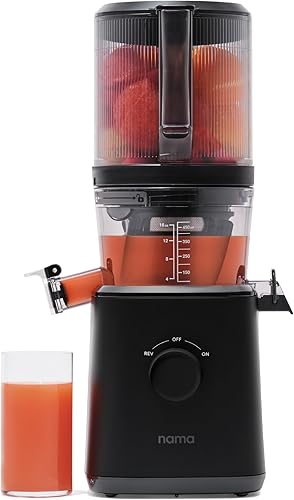
The Nama suits someone who washes and prepares a recipe before switching the juicer on. Its self-feeding hopper lets you load that recipe at once instead of adding every piece separately.
That changes where you spend your effort: more preparation up front, with less repeated feeding afterward. It doesn't remove the need to sort produce, follow loading directions or watch the juice and pulp containers.
Choose it if feeding interrupts the rest of your breakfast routine. Skip it if hand washing is the chore most likely to stop you from making juice.
Nama includes quick-release parts and a cleaning brush, and backs the J2 with a 15-year warranty. Read the warranty terms before relying on coverage for a particular part.
Omega All-in-One Cold Press Juicer: for cooks who want more uses
The Omega suits a kitchen where juicing shares time with making nut butter, baby food, pasta or sorbet. Its included homogenizing cone and 6 breadstick and pasta nozzles support those extra tasks.
Choose it if you can name the foods you'll make beyond juice. Skip it if those attachments sound appealing but would spend most of the year in a drawer.
Changing jobs means selecting the right parts and following a different preparation method. Keep the attachments together so a missing nozzle doesn't turn a quick kitchen task into a search.
Does the name tell you how much pulp you'll get?
No, filters and ingredients determine texture more directly than the label. Choose a model with clear pulp options if different people in your home prefer different drinks.
The Ninja offers the simplest named choice here. The Nama includes a juice strainer and a coarse strainer, while the Omega includes a sieve for further straining.
Choose your filter before assembling the machine. Switching halfway through a batch adds handling and cleanup, so separate recipes by texture preference when possible.
Even with the same filter, a soft fruit blend can feel different from a carrot-heavy drink. If you want a very smooth glass, allow for a separate straining step and another item to wash.
A pulpy juice also isn't the same as a smoothie made with the whole ingredient. Juicers separate out solids, so don't choose a pulp setting expecting it to retain everything you started with.
Which style is easier to clean?
Cleanup depends on the exact model and its care rules. The shared cold press and masticating labels give you no useful shortcut.
The Ninja's juice-contact parts are dishwasher safe. The Nama is hand wash only, while Omega permits sink cleaning or top-rack dishwasher care for appropriate parts.
Dishwasher compatibility doesn't remove every step. You'll still need to unplug the machine, take it apart, empty the pulp and clear trapped fibers before washing.
Rinse removable parts soon after juicing, while the residue is wet. Brush screen openings gently, paying attention to seams and outlets where pulp can collect.
Keep the motor base out of water and wipe it according to the manual. Let washed pieces dry fully before storing them together.
Our cold press juicer cleaning guide explains the routine in more detail. If you dislike cleaning fine screens, make that a deciding factor rather than assuming a different name will solve it.
What should you measure before choosing a juicer?
Measure the working space, not just the storage space. You need room for the machine, collection containers, ingredient loading and removing the upper parts.
| Model | Depth x width x height |
|---|---|
| Ninja NeverClog JC151 | 12.11 x 7.15 x 15.93 in |
| Nama J2 Hands-Free Juicer | 9 x 9.8 x 17.7 in |
| Omega All-in-One Cold Press Juicer | 19.69 x 7.09 x 13 in |
The Nama needs the most height of these 3, while the Omega reaches furthest along the counter. The Ninja is narrower than the Nama, but its containers still need their own space.
Use a piece of paper to mark each footprint on your counter. Place bowls beside it, then check whether you can still reach the sink and prepare produce comfortably.
If the machine will live in a cupboard, consider lifting it too. The Ninja weighs 7.9 lb, the Nama 12.1 lb and the Omega 14.1 lb.
A machine that fits under a cabinet may still need to slide forward for loading or disassembly. Leave room for those movements before deciding where it will stay.
How should you set up and feed a slow juicer?
Prepare the produce first, assemble the correct parts and feed without forcing. This keeps you from handling a full juice container while searching for a knife or missing filter.
Before you switch it on
Read the model's assembly order and seat the auger, filter, chamber and lid as directed. A part that looks nearly aligned may still prevent proper operation.
Set the machine on a dry, stable counter near a suitable outlet. Position both collection containers and check the juice outlet before starting.
Wash produce, remove hard pits and prepare peels as directed for each ingredient. A roomy hopper doesn't make stones, tough skins or oversized pieces suitable for juicing.
Cut long fibrous stalks across their length when the manual calls for it. Our guide to juicing celery in a juicer covers preparation for that common ingredient.
While the auger is working
Give the machine time to process what you've added. Use only the supplied pusher where directed, and keep fingers and utensils out of the feed opening.
For mixed recipes, alternate suitable firm ingredients with leaves or softer pieces as the manual allows. Avoid compressing a large bundle of greens into a tight plug.
If flow slows or the motor strains, stop adding produce. Use the model's jam-clearing procedure, and unplug it before opening the chamber or removing trapped material.
A Reverse button helps with some blockages, but it isn't a reason to keep overfeeding. Repeated trouble calls for smaller pieces, a slower pace or clearing accumulated pulp.
Which common mistakes make the buying decision harder?
Comparing headline numbers without planning your routine leads to poor choices. Work through the full cycle from washing produce to putting the parts away.
Treating watts or RPM as a quality ranking
The Ninja has a 150-watt motor; the Nama and Omega have 200-watt motors. That difference alone doesn't rank juice yield, texture or ease of use.
Likewise, the Nama's 50 RPM and Omega's 80 RPM describe rotation speed. Neither figure measures chopping time, feeding attention or screen cleaning.
Buying capacity you won't use
Plan around the amount you'll drink, rather than the largest batch you could make. Larger recipes require more produce preparation, container management and storage afterward.
For occasional juice, a complicated setup may outweigh the benefit of making it at home. Count cleanup as part of the job when deciding how often you'll realistically use the machine.
Expecting every fruit to behave alike
Firm apples, leafy greens and very soft fruit don't move through a juicer in the same way. Follow ingredient guidance instead of assuming anything that fits in the opening will make clear juice.
For frozen desserts or other food tasks, use only the correct supported setup. Don't run frozen ingredients through a juice screen simply because a machine has another food-making function.
Letting attachments decide the purchase
Extra functions are useful when they replace a task you already do. Otherwise, prioritize the feeding and washing steps you'll repeat with every glass.
Our guide to choosing a juicer by chute, auger, pulp and cleaning helps turn those priorities into a short shopping checklist.
Which one should you choose?
Settle the cold press juicer vs masticating juicer question by choosing a routine, not a label. These machines share an extraction approach, but ask different things of you before and after each batch.
Pick the Ninja NeverClog JC151 if texture choices and dishwasher cleanup are your priorities. Its simpler juice-focused setup suits someone who expects to stay nearby and feed ingredients.
Choose the Nama J2 Hands-Free Juicer if repeated feeding is your biggest nuisance. Make that choice only if hand washing and the space needed for loading fit your kitchen.
Pick the Omega All-in-One Cold Press Juicer if food prep beyond juice is a firm plan. Its attachments make more sense for a cook who will use them than for someone seeking only a daily glass.
If none matches your routine, compare the best cold press juicers and best masticating juicers using the same priorities. Keep feeding effort, washing method and working space at the top of your shortlist.
Frequently asked questions
Is a cold press juicer the same as a masticating juicer?
Usually, yes. In home juicers, cold press and masticating commonly describe a slow machine that crushes and presses produce with an auger.
The names don't tell you how you load ingredients or wash the parts, so compare those details before choosing a model.
Does a cold press juicer always run at the same speed?
No, operating speed varies between models. The Nama J2 runs at 50 RPM, while the Omega All-in-One runs at 80 RPM.
Those figures describe auger speed, not how long your whole recipe takes.
Include chopping, feeding, emptying containers and washing when comparing the time each routine needs.
Which is easier to clean, a cold press or masticating juicer?
Neither label determines cleanup because they often describe the same machine type. The Ninja JC151 has dishwasher-safe juice-contact parts, while the Nama J2 requires hand washing.
Choose around your washing routine, then rinse pulp away promptly and clean the screen before residue dries into its small openings.
Can a masticating juicer handle leafy greens?
Yes, all 3 models here are designed to process leafy greens. Preparation still matters: wash leaves, cut long fibrous stems as directed and avoid packing a large wad into the feed opening.
Our guide to cold press juicers for leafy greens explains how to build and feed a green juice recipe.
Should I choose a masticating or centrifugal juicer?
Choose a masticating model if you want slow auger extraction, then compare its feeding and cleanup needs with a centrifugal model's routine. A centrifugal juicer uses a fast-spinning cutting basket.
Our centrifugal vs masticating juicer guide explains the differences that matter when you're choosing between these genuinely different mechanisms.


