How Much Does a Good Juicer Cost?
How much is a good juicer worth spending on? Choose a model that covers your usual ingredients, batch size, and cleaning needs, then pay more only for convenience you’ll use often.
On this page (7 sections)
A good juicer is worth spending on when it fits your ingredients, serving size, and cleanup routine. If you’re asking how much is a good juicer, start with those needs and pay extra only for features that remove a regular chore.
Budget, mid-range, and premium labels don’t tell you whether a machine belongs in your kitchen. A large hopper helps with family batches, while a simpler juice-only design may cover everything an occasional user needs.
Before comparing models, write down your usual recipe and how often you expect to make it. Our juicer buying guide explains the chute, auger, pulp, and cleaning details behind that choice.
How much is a good juicer for your needs?
Set your spending limit around the routine you can maintain. Include the effort of shopping for produce, preparing it, and washing the machine after each session.
How much should a good juicer do for occasional use?
For occasional juice, prioritize straightforward assembly and storage over a long feature list. A machine that takes up your only prep area can become inconvenient even if you use it just once a week.
Start your comparison with budget juicers. Keep only models that suit your ingredients and available space, then decide whether any added convenience deserves more of your budget.
What makes spending more worthwhile for frequent use?
For frequent juicing, pay attention to the task you’ll repeat most. Less chopping matters if prep slows you down; batch loading matters if feeding ingredients one at a time interrupts your morning.
Count ingredients as part of the ongoing commitment, too. If you’re unsure you’ll keep buying produce and washing parts, read whether a juicer is worth it before choosing a more involved setup.
Which features are worth paying more for?
Pay more for a specific job made easier, such as loading several servings or making frozen fruit sorbet. Motor wattage and rotation speed alone don’t establish which machine will suit your recipes best.
A wide chute can reduce cutting, but it doesn’t remove all preparation. Wash produce, remove hard pits, and follow the instructions for peels, seeds, and fibrous ingredients.
A batch hopper changes how you load the machine. Its capacity describes the ingredients it holds, not how much finished juice you’ll get, so don’t match hopper volume directly to your drinking container.
Extra functions deserve space in your budget only if you have recipes for them. If sorbet and nut milk sound appealing but aren’t foods you normally make, treat them as optional.
Warranty coverage also needs a close read. A motor warranty and a warranty covering the juicer can have different scopes, so compare the terms rather than the number of years alone.
Which juicer fits your routine?
Choose the machine whose main feature solves your main problem. These four options suit different routines; there’s no need to pay for every possible use.
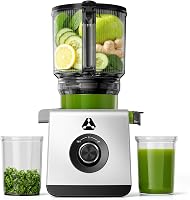
TUUMIIST 5.8-Inch: for a straightforward juice routine
Choose this TUUMIIST if reducing chopping matters more than making other foods. Its simple one-piece design and included brush make it a useful starting point for shoppers focused on juice.
At 8 x 8 x 17 in, it gives you a clear starting point for measuring counter space. Allow extra room for the juice and pulp cups, plus clearance to open and remove the hopper.
Assembly deserves attention on the first use. TUUMIIST instructs you to keep the cover open and turn the hopper clockwise until its guide mark lines up with the chamber’s lock symbol.
Skip this option if sorbet or nut milk is part of your buying plan. Also, confirm which parts can go in the dishwasher before using one, since TUUMIIST provides both dishwasher-safe and hand-wash care directions.
TUUMIIST 3-in-1: for several recipes with one strainer
Choose the TUUMIIST 3-in-1 if you want juice, nut milk, and sorbet without switching strainers. That design suits a household that plans to use the machine for more than a morning drink.
Its 100 oz hopper supports loading a batch at once. Quick-release parts and an included brush are useful features for the washing routine that follows.
Measure carefully if your counter is narrow: the machine is 7 in deep, 13 in wide, and 17 in tall. Keep its working area close enough to the sink that carrying wet parts won’t become a daily nuisance.
Skip it if you only want occasional juice and have no plans for the other functions. One strainer reduces accessory swapping, but you still need to wash the food-contact parts between different recipes.
Canoly C16: for family batches and varied recipes
Choose the Canoly C16 if you want batch loading, sorbet and nut milk options, and a detachable pulp outlet. That removable outlet gives you access to an area where pulp can collect.
The C16 uses separate juice and sorbet strainers, so plan a place to store the unused one. Keep the correct strainer with your recipe supplies to avoid assembling the machine twice.
Canoly backs the motor with a 15-year warranty; read its terms to understand the coverage. The machine weighs 12.6 lb, which also matters if you plan to lift it out of a cabinet each morning.
Skip it if you want one strainer for every function or prefer a machine you can move with less effort. Its batch features make more sense when you have several servings or different recipes planned.
Nama J2: for regular self-feeding juice prep
Choose the Nama J2 if you want to load a recipe together and do other kitchen tasks nearby. Its self-feeding hopper suits a regular juicing routine built around preparing a batch.
The J2 includes juice and coarse strainers, a cleaning brush, and quick-release parts. Nama backs it with a 15-year warranty, which makes the coverage terms worth comparing if you expect frequent use.
Plan for hand washing and a machine that stands 17.7 in tall. Check the space beneath your cabinets and leave room to lift parts off for cleaning.
Skip it if dishwasher cleanup is a firm requirement. Self-feeding also doesn’t remove the need to prepare ingredients correctly, watch the containers, and stay nearby during operation.
How should you set up and use a new juicer?
Start with a small, familiar recipe so you can learn assembly, feeding, and cleanup without handling a large batch. Set the machine on a stable, dry counter with the juice and pulp containers in place.
Fit the parts in the order shown in the manual. If the machine won’t start, check its assembly and locking points before adding more ingredients.
Prepare everything before switching it on. For fibrous produce such as celery, follow the model’s cutting guidance even when the stalks fit through the chute.
Let the auger draw ingredients through, and use only the supplied pusher when needed. Stop the machine before opening it or clearing trapped food, following its safety instructions.
For a fuller walkthrough, use our guide to how to use a cold press juicer.
How much cleaning should you plan for?
Plan to clean after every session, including small batches. A large hopper can reduce loading work, but it doesn’t remove pulp from the chamber, outlet, or strainer.
Switch off and unplug the machine before taking it apart. Empty the pulp, rinse removable food-contact parts promptly, and use the brush gently where fibers collect.
Wash each part according to its care instructions, then let it dry before reassembly or storage. Keep the motor base out of the sink and wipe it as directed.
Don’t judge cleanup by the strainer alone. Check whether you can reach the pulp outlet, seals, and narrow channels; our cold press juicer cleaning guide explains the routine.
Which buying mistakes waste the most money?
The biggest mistake is buying for an imagined routine. Choose for the juice you’ll actually make, rather than a long menu of recipes you may never try.
Avoid these other shortcuts:
- Choosing by wattage alone: More watts don’t tell you the yield, texture, or cleanup effort for your recipe.
- Confusing hopper size with juice output: Ingredients leave pulp behind, so loaded volume isn’t finished drink volume.
- Measuring only the machine: Cups, accessories, opening clearance, and drying space also need room.
- Skipping care instructions: Dishwasher use must match the directions for each part.
- Treating every warranty alike: Check what is covered and what you’d need to make a claim.
Use juicer brands compared to narrow your research, then compare the individual models against the same requirements.
How much is a good juicer worth spending on?
Choose a good juicer by the chore you most want to reduce. If chopping is your main concern, start with the TUUMIIST 5.8-Inch; if you want several food options with one strainer, consider the TUUMIIST 3-in-1.
Choose the Canoly C16 for family batches and access to its removable pulp outlet. Choose the Nama J2 for self-feeding recipe loading when hand washing fits your routine.
If you can’t name the feature that makes the more costly option useful to you, keep comparing simpler models. The complete cold press juicer guide can help you settle the design choice before committing your budget.
Frequently asked questions
How much should I spend on a good juicer?
Spend enough to cover your usual ingredients, serving size, and cleaning needs. Start with models that meet those requirements, then compare convenience features within your budget.
A batch hopper matters for several servings; sorbet and nut milk functions matter only if you plan to use them.
Is an expensive juicer worth it?
An expensive juicer is worth considering when it removes a task that would otherwise keep you from juicing regularly. Look for useful loading features, manageable cleanup, and warranty coverage you understand.
For occasional juice, extra functions and a larger hopper may add little value to your routine.
Are cold press juicers more expensive?
Cold press describes the extraction method, not a fixed budget tier. Models differ in hopper design, accessories, controls, and warranty coverage, so compare those details before deciding what to spend.
Our guide to cold press juicers explains how the design works and what it means for daily use.
What should I look for in a budget juicer?
Look for a machine that suits your usual produce and is practical to assemble, clean, and store. Measure the counter space and check care instructions before choosing.
Keep your first recipes simple so you can judge whether the preparation and washing fit your schedule before buying extra accessories.