Hurom H320 Juicer Review: Worth It? (November 2026)
The Hurom H320 is a strong buy for families who want low-pulp juice from whole produce. Its coarse and fine strainers, self-feeding hopper and quiet motor suit daily juicing, and the H400 is the easier-clean choice if hand washing puts you off.
On this page (7 sections)
The Hurom H320 is a strong buy for families who juice daily and want to dial in pulp. Two strainers, a control lever and a self-feeding hopper that takes whole produce make it the most capable slow juicer in this comparison.
Its weak points are hand washing and a single speed.
If quick cleanup matters more than pulp control, the H400 is the easier pick. Read on for how the H320 handles daily juicing and where the alternatives fit.
The Hurom H320 at a glance
The H320 is a cold press masticating juicer built around a family-size hopper and adjustable pulp. Hurom squeezes produce with an auger rather than spinning a blade at high speed, and it pairs that with two strainers so you can choose how much pulp lands in the glass.
Hurom H320 Cold Press Juicer Machine: Best for families who juice daily
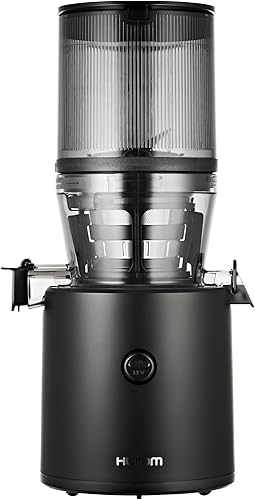
- 2 liter self-feeding hopper
- Fine and coarse strainers with control lever
- 150-watt quiet AC motor
- Hand wash only
A family-size slow juicer with real pulp control. It squeezes whole fruit and vegetables through a self-feeding hopper and stays quiet enough for early mornings.
Pros
- Two strainers plus a control lever let you set pulp level
- Hopper takes whole produce and keeps feeding while running
- Near-silent AC motor suits early mornings
- Slow Squeeze tech limits oxidation
Cons
- Hand wash only, with several parts to clean
- Single speed
- Bigger footprint than compact models
The 2 liter hopper fits whole fruit, and the inlet stays open so you can keep adding ingredients while the motor runs. That's the feature that separates it from smaller personal juicers in this category.
Hurom rates the machine for a long list of everyday produce, from apples, carrots, celery and cucumber to leafy kale, plus citrus, ginger and beetroot. Anything you can chew, the company says, its augers can press.
The auger squeezes the produce like a hand-squeezer, so the pulp comes out bone dry and the juice stays in your glass rather than in the waste bin. Hurom has been building slow juicers for over 50 years, and the H320 sits in its Easy Clean line alongside the H400, H200 and H310A models.
The auger and strainer are the working parts, and the 150-watt AC motor turns them slowly rather than spinning a basket at speed.
Who this Hurom H320 review is for
You'll get the most from this juicer if you make juice for more than one person and do it several times a week. A family that goes through apples, carrots and greens quickly will appreciate feeding whole produce and adjusting pulp without changing machines.
It's also a fit if you juice before the household wakes. Hurom calls the AC motor whisper quiet, and a slow auger runs quieter than a high-speed centrifuge.
That matters in a shared home where a loud motor would wake people or put you off juicing early.
Skip it if you want minimal cleanup or you only juice occasionally. The hand-wash requirement and the number of parts make it more of a daily-use appliance than an occasional one.
For a single person who juices a glass now and then, the 2 liter hopper is more capacity than you need, and a compact model would serve you with less washing.
The specs that matter in daily use
The number that matters most is the hopper capacity, not the motor wattage. Two liters of feed room and a wide inlet mean fewer stops to cut fruit, which is where slow juicers usually lose time.
The 150-watt motor runs at a single speed and does the job without a lot of noise.
Pulp control is the standout feature. A fine strainer gives smoother juice, and a coarse strainer leaves more body.
The control lever lets you move between them to suit the recipe, so you aren't locked into one texture. That's unusual for a slow juicer, where many models ship with one strainer and leave you to strain again by hand.
Hurom's Slow Squeeze technology is the brand's answer to oxidation. Hurom says it extracts juice with minimal oxidation and keeps the fresh taste for up to 72 hours.
Treat that as the maker's guidance and chill your juice in a sealed bottle. The same slow squeeze is what Hurom credits for a higher yield, since the auger works the pulp until little juice is left in it.
The footprint is worth checking before you buy. At 16.3 inches deep and 13.7 inches wide, it needs real counter space.
The matte black finish is neutral enough to leave out, which helps if you juice often. It weighs 6.15 kg, so it's stable on the counter but not a machine you'll want to lift in and out of a cupboard every morning.
The auger's blade material is Ultem, a tough plastic, and the body itself is plastic with the matte black finish.
Plan around a standard 120-volt outlet. The controls are simple buttons, and there's one speed to manage.
Setting up and running the H320
Setup is straightforward enough for beginners and veterans alike, which Hurom highlights as a selling point. The parts assemble in a clear order, and the self-feeding hopper does most of the work once you start.
There's no complicated control panel to learn, just the lever for pulp and the on button.
Load whole produce into the hopper and let the auger pull it down. Cut anything that won't fit the inlet, and remove hard pits and stones before juicing, as with any slow juicer.
The open inlet lets you add more while it runs, so you can keep a steady flow going instead of stopping to reload.
Choose your strainer first. Use the fine one for a cleaner juice and the coarse one when you want texture.
Move the control lever to match, then adjust to taste over a few sessions. If you like a pulpy morning juice and a clearer one for guests, you can switch strainers between batches without much fuss.
The single speed keeps operation simple. You don't manage settings mid-run, which suits a morning routine where you want to load and walk away.
The self-feeding action means you can step back and let the auger draw produce down while you do something else.
If you're new to slow juicing, our guide to the best juicers for beginners covers the basics of feeding and cleaning an auger machine.
Cleaning and care after each session
Plan on hand washing every session, because Hurom lists hand wash only for the H320. Rinse the strainer and auger promptly so pulp doesn't dry and stick, and use a brush for the fine mesh.
Cleaning right after juicing is far easier than leaving it until later, when the fiber sets and takes more scrubbing.
The strainer is the part that takes the most attention. Fine mesh traps fiber, so run water through it from the back and brush gently rather than pressing hard.
The control lever and the auger also collect pulp and need a rinse before you reassemble. Dry the parts fully before reassembling so nothing sits damp and odorous.
The motor base wipes clean with a damp cloth. Keep water out of it and never submerge the base.
Store the juicer assembled or in its parts, whichever makes the next session easier. If you leave it assembled on the counter, the matte black finish and the modest 12.4 inch height help it look tidy enough for everyday use.
Hand washing is the real cost of ownership here. If you know you'll skip a brush-down after a busy morning, the easy-clean design of the H400 is worth the trade in pulp control.
The H320 rewards the person who builds a short cleaning habit into the routine, not the one who leaves parts in the sink until the next day.
Our use and care guide for slow juicers walks through routine cleaning and storage in more detail.
The trade-offs to weigh before buying
The H320's biggest trade-off is cleanup, followed by its footprint and single speed. Hand washing a strainer and auger after every session is more work than rinsing a dishwasher-safe basket.
The strainer and auger are yours to scrub each time. It's also a large machine, at 16.3 inches deep and 13.7 inches wide, so it takes a real slice of counter space.
Measure before you commit. If your kitchen is tight, a compact model may fit better.
The 12.4 inch height is modest enough to slide under most upper cabinets, which helps.
The single speed is fine for most produce, but it gives you no separate setting for soft fruit versus hard roots. You manage texture through the strainers instead.
Some buyers want more control than that, and a variable speed or a reverse switch would have answered that wish. The H320 offers one speed and simple button controls.
Finally, the pulp control is the reason to pay for this model. If you don't care whether your juice is smooth or textured, you're paying for a feature you won't use.
For a buyer who simply wants juice from whole produce, the H400 does that job with less cleaning, and the strainer pair here is the extra you'd be paying for.
Alternatives worth comparing
Two machines here cover the needs the H320 doesn't serve as well: easier cleanup and a lower-cost 3-in-1 option. Both are worth a look before you settle.
Hurom H400 Easy Clean Slow Juicer
The H400 is the model to pick when cleanup speed beats pulp control. It carries Hurom's easy-clean design as its headline feature, along with a hands-free hopper that fits whole produce, a quiet motor and BPA-free construction.
Assembly is simple.
Hurom includes a juice container, cleaning brush and recipe book with the H400, so you can start juicing without buying extras.
It also runs a 150-watt motor and hand wash care, so the cleaning routine is still yours. What changes is how quickly the parts come apart and rinse.
Hurom lists nuts and seeds among its recommended uses alongside fruits and vegetables. If the H320's strainer pair sounds like more fiddling than you want, this is the one to choose.
Its tall, narrow body is 10.3 inches deep and 6.6 inches wide, so it takes less counter depth than the H320.
ACOQOOS 3-in-1 6.5-Inch Juicer
The ACOQOOS is the pick when you want juice, sorbet and nut milk from one machine at a lower cost. It has a 6.5-inch chute for whole fruit, a 100 oz gravity-fed hopper, a 60 RPM cold press system and dishwasher-safe detachable parts.
It's also BPA-free.
The 350-watt motor turns the auger slowly at 60 RPM to limit heat and oxidation, and ACOQOOS says the yield reaches around 90 percent.
The trade-offs are real. It scores lower here, and ACOQOOS asks you to remove hard pits and seeds before juicing.
Its gravity-fed hopper rewards a little loading order, with soft greens at the bottom and heavier produce on top. It's also lighter than the Hurom at 8.7 pounds and stands 14.8 inches tall.
The 1-year warranty is shorter than Hurom's 50-year track record suggests. For a family that only juices, the H320's pulp control is the better fit.
Is the Hurom H320 juicer worth it?
The Hurom H320 is worth it for families who juice most days and want control over pulp. Two strainers, a control lever, a 2 liter self-feeding hopper and a near-silent motor make it the strongest all-round slow juicer in this comparison.
Our score weighs specs, features and the fit with daily family juicing.
Buy it if you'll use the pulp lever and feed whole produce several times a week. Pick the H400 if easy cleanup is the deciding factor, or the ACOQOOS if sorbet and nut milk matter and budget is tighter.
The H320 asks for counter space and a cleaning habit, and in return it gives you juice you can tailor to the glass and a motor quiet enough for early mornings.
For the wider field, compare how Hurom stacks up against rivals in our juicer brands guide. If you want to see how another slow juicer handles a similar job, read our Nama J2 review before you decide.
And if cost is the main constraint, the best juicer on a budget roundup covers cheaper options.
The bottom line: this Hurom H320 juicer review finds it the best family slow juicer here for pulp control and quiet operation, with hand washing as the price you pay.
Frequently asked questions
How does the Hurom H320 control pulp?
It uses a control lever with a fine strainer and a coarse strainer. The fine strainer gives smoother juice with less pulp, while the coarse strainer leaves more texture.
You set the lever to match how you like your glass.
Can the Hurom H320 take whole fruit?
Its high-volume self-feeding hopper is built to fit whole produce, and the wider inlet lets you add more ingredients while it runs. Cut anything too large for the opening and remove hard pits and stones first, as with any slow juicer.
Does the Hurom H320 need hand washing?
Yes. Hurom lists hand wash only for this model, so budget a few minutes to rinse and brush the strainer and auger after each session.
The H400's easy-clean design reduces that chore if cleanup is your main concern.
How quiet is the Hurom H320?
Hurom describes the AC motor as near-silent and whisper quiet. It's a slow juicer running at low speed rather than a high-speed centrifuge, so the sound should be gentle enough for early mornings.
How long does H320 juice stay fresh?
Hurom says its Slow Squeeze technology limits oxidation so the juice keeps its fresh taste for up to 72 hours. Chill it in a sealed container and treat that as the maker's guidance rather than a guarantee for every recipe.


