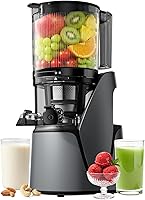
Hurom H-AA Slow Juicer Review: Worth It? (November 2026)
The Hurom H-AA Slow Juicer is worth buying if you want quiet cold-press juice with adjustable pulp and you mainly feed leafy greens, fruit and nuts. Skip it if you want to drop whole apples into a wide chute or juice for a big family in one run.
On this page (7 sections)
The Hurom H-AA Slow Juicer is the best pick here for quiet daily juicing, because it pairs a 150-watt slow motor with two strainers that let you set pulp how you like it. Buy it for small batches of greens, fruit and nut milk.
The 500 ml chamber is the main reason to look elsewhere if you juice for a whole family in one go.
This Hurom H-AA slow juicer review focuses on the details that affect daily use: how much it makes, how loud it runs, what the strainers do and how it cleans. The alternatives below are the two machines we would point different buyers toward.
Our score weighs specs, features and buyer feedback against what you're shopping for.
The Hurom H-AA at a glance
The H-AA is a compact slow juicer with a 500 ml chamber and a 150-watt motor, built around Hurom's Alpha Technology. It sits upright on the counter at 7.8 by 8.8 by 16 inches and weighs 10.8 lb.
The polished white finish is easy to wipe down, though Hurom lists the body material as ABS plastic.
Hurom H-AA Slow Juicer: Best for quiet daily greens

- 500 ml chamber
- 150-watt motor
- Fine and coarse strainers
- Ice cream strainer included
A compact, quiet slow juicer with two strainers and an ice cream option. It suits small daily batches of greens, fruit and nut milk more than large family runs.
Pros
- Quiet 150-watt motor
- Fine and coarse strainers control pulp
- Makes ice cream and nut milk
- Ultem strainer and auger rated 8x stronger than standard plastic
Cons
- Small 500 ml chamber means more than one pass for big batches
- Hand wash only
- Narrow feed means cutting produce first
What sets it apart from cheaper slow juicers is the strainer set. You get a fine strainer, a coarse strainer and an ice cream strainer in the box, plus two augers and a spinning brush for cleanup.
That range is unusual at this size.
The H-AA also carries the Hurom name, which matters if brand reputation and a long track record are part of your decision. Our comparison of juicer brands puts Hurom next to Nama and Ninja.
The blade material is stainless steel and the controller is a simple button setup rather than a touchscreen. That keeps operation basic: you press start and let the auger turn.
The box also includes a pusher, juice and pulp containers, a drying rack and both a large and a small cleaning brush.
Who the Hurom H-AA suits
Buy it if you make one or two glasses of juice at a time and want the least noise possible in a small kitchen. It's also a good fit if you change up ingredients often, since the pulp lever and two strainers let you move between clear juice and a thicker drink without swapping machines.
Skip it if your routine means juicing a week's worth in one session. The chamber fills quickly, so you'll empty the pulp container and reload produce more often than with a wide-hopper machine.
The ingredient list is where the H-AA earns its keep for a certain kind of shopper. Hurom lists fruits, cruciferous vegetables, leafy greens, nuts and soybeans, so you can move from kale to almonds to soaked soy for tofu without changing machines.
A home cook who likes variety will get more out of that than someone who only ever juices oranges.
The specs that matter in daily use
The 150-watt motor and slow auger are the core of the H-AA, and they shape how it behaves every morning. Low speed means less heat and less oxidation, which Hurom says keeps juice fresh for up to 72 hours.
Treat that as Hurom's claim and still store juice cold.
The 500 ml chamber holds about 16.9 oz. That's roughly two small glasses, so it's a personal juicer rather than a family machine.
If you routinely juice for three or more people, expect to run it twice.
The taste and pulp control comes from a lever plus the fine and coarse strainers. Fine gives you clearer juice; coarse leaves more body.
The ice cream strainer turns frozen fruit into a dessert, which is a feature most slow juicers this size leave out.
Durability gets a real boost from the Ultem strainer and auger. Hurom says they are 8 times stronger than traditional plastics.
The 10.8 lb weight also helps it stay put while the auger presses.
The footprint is worth planning around. At 7.8 inches deep and 8.8 inches wide it takes less counter than many blenders, but the 16 inch height means it needs clearance under a cabinet.
Measure that gap before you buy, because a juicer you have to shuffle around gets used less.
Setting up the H-AA for the first time
Setup is quick and tool-free, which Hurom lists as one of the H-AA's selling points. The box includes the body, hopper, hopper lid, auger, bowl, strainers, juice container, pulp container, pusher, drying rack and cleaning brushes.
Start by washing every part that touches food before the first run. Then seat the bowl on the body, fit the strainer you want, drop in the auger and lock the hopper on top.
The pieces only fit one way, so follow the manual the first time.
Place the juice and pulp containers under their spouts and check both are fully seated. A container that's slightly off can spill juice across the counter.
Feed produce with the pusher rather than your fingers, and cut items to fit the hopper opening. The H-AA isn't a whole-fruit machine, so apples and carrots need reducing first.
If wide feeding matters more, see our juicer for beginners picks.
Once the routine is familiar, loading takes seconds. The trick is to feed slowly and let the auger clear before adding the next handful.
Packing the hopper full slows the press and can back juice up into the chamber. A steady rhythm beats a fast one with this machine.
Cleaning and care after each session
The H-AA is hand wash only, so cleaning takes a few minutes rather than a dishwasher cycle. Rinse the bowl, strainer and auger as soon as you finish, before pulp dries into the grooves.
The included spinning brush helps loosen pulp from the strainer, and the small brush reaches the auger's tight spots. Hurom's grooved strainer design is meant to make this easier than the old small-hole style.
Dry the parts before reassembling so moisture doesn't sit in the base. Wipe the body with a damp cloth and keep the power cord away from water.
Store the extra strainer and auger with the drying rack so they don't get lost between uses. A quick rinse each time keeps the Ultem parts working as intended and avoids a deep clean later.
The drying rack matters more than it sounds. Wet strainer grooves trap pulp and odor, so letting the parts air dry upside down before you stack them keeps the next batch tasting clean.
If you juice leafy greens, rinse the strainer under running water first and then use the brush, because the fine holes clog faster with fibrous material.
Where the Hurom H-AA falls short
The biggest trade-off is capacity, not quality. A 500 ml chamber means more reloading than a wide-hopper machine, and the narrow feed opening means you'll cut produce first.
That's the price of a compact footprint.
Hand washing is the second compromise. The strainer and auger have to be cleaned by hand every time, which adds minutes to a busy morning.
A dishwasher-safe rival saves effort if that's a priority for you.
The H-AA also costs more than a basic centrifugal juicer. You're paying for slow pressing, quiet operation and the strainer set.
If you only juice occasionally and don't care about noise or oxidation, that premium is harder to justify.
Finally, the plastic body won't feel as solid as a metal-clad machine. Hurom uses strong Ultem for the working parts, but the exterior is ABS.
Handle the base carefully when moving it.
There's also a speed trade-off. A slow auger is gentle on nutrients, but it takes longer to press a given amount of produce than a high-speed centrifugal juicer.
For two glasses that's fine. For a large batch it adds up, on top of the reloading.
Alternatives worth comparing
Two machines make more sense for specific buyers, and each earns its place on a different need. Neither replaces the H-AA as our overall pick for quiet small-batch juicing.
Hurom H330 for hands-off batches
The Hurom H330 is the better pick if you want to load whole produce and walk away. Its 2-liter self-feeding hopper takes whole apples, carrots and celery without pre-cutting.
It runs at 50 RPM and Hurom says it keeps nutrients intact with less foam and heat.
The H330 also carries a 15-year warranty and is made in Korea. The catch is size: at 18 inches wide it takes up far more counter than the H-AA.
The ice cream strainer is sold separately here, unlike on the H-AA. Our Hurom H320 juicer review covers the closest sibling in the same family.
Its safety shut-off is a nice touch for a family kitchen. If the hopper lid opens mid-cycle the motor stops, then restarts when the lid closes.
That's the kind of detail a household with kids notices, and it's one more reason the H330 reads as the family machine while the H-AA reads as the personal one.
TUUMIIST Smart Touch 3-in-1 for big families
The TUUMIIST Smart Touch 3-in-1 suits households that juice in volume and want a wide chute. Its 6.5-inch chute takes whole apples and celery, and the 100 oz pitcher holds a large batch in one run.
A touchscreen switches between juice, nut milk and sorbet.
It has a 350-watt motor, auto-reverse to clear jams and a 3-liter capacity. The trade-off is footprint and overall build, which is why it scores below the two Huroms.
If you're weighing Hurom against Nama on features and price, our Nama J2 review is the direct comparison.
The dishwasher-safe care instructions are the other draw. Where the H-AA needs hand washing, the TUUMIIST can go in the machine, which matters if cleanup is the part that stops you juicing.
It also lists overheat protection and a metal-free filter mesh among its features.
Verdict: should you buy the Hurom H-AA?
Buy the Hurom H-AA if you want a quiet, compact slow juicer for small daily batches, and if adjustable pulp and an included ice cream strainer matter to you. It's the best pick here for most people who juice a glass or two at a time.
Choose the Hurom H330 instead if you want a self-feeding hopper and a longer warranty for family-size batches. Pick the TUUMIIST if a wide chute and a big pitcher matter more than build quality.
Otherwise, the H-AA is the simplest way to get slow, cold-press juice without giving up counter space.
Whichever you choose, cut produce to fit the feed and rinse the parts right after juicing. That habit does more for your daily routine than any spec on this page.
Frequently asked questions
How loud is the Hurom H-AA Slow Juicer?
Hurom describes the H-AA motor as quiet and says you can start juicing in the morning without a stir. The motor is rated at 150 watts and runs at slow auger speed rather than high blade speed.
Can the Hurom H-AA make nut milk and ice cream?
Yes. Hurom lists nut milk, tofu and ice cream among what the H-AA can make, and the box includes an ice cream strainer.
You feed nuts or frozen fruit slowly and let the auger press them.
Is the Hurom H-AA dishwasher safe?
No. Hurom gives the H-AA hand wash only care instructions.
Plan on rinsing the chamber and strainers soon after each use and drying them before reassembly.
How long does H-AA juice stay fresh?
Hurom says the slow squeeze technology keeps juice fresh for up to 72 hours. That is Hurom's claim, so keep juice chilled in a sealed container and use your own judgment on taste and smell.
What is the difference between the Hurom H-AA and the Hurom H330?
The H-AA has a 500 ml chamber and you feed produce through a standard hopper. The H330 adds a 2-liter self-feeding hopper for whole produce, a wider footprint and a 15-year warranty.