9 Best Masticating Juicer for Leafy Greens (November 2026)
The best masticating juicers for leafy greens include the EanOruus 3-in-1 Cold Press Juicer for most green juice drinkers, the Ninja NeverClog JC151 for clump-free green juice, and the Nama J2 for hands-free big batches.
On this page (8 sections)
- Best masticating juicers for green juice, ranked
- How these juicers compare
- What matters most when juicing leafy greens?
- Which leafy greens juice best in a masticating juicer?
- How wide a chute do you need for green juice?
- Do you need a reverse function for leafy greens?
- Which slow juicer is easiest to clean after greens?
- Verdict: which masticating juicer should you buy for greens?
The best masticating juicer for leafy greens for most people is the EanOruus 3-in-1 Cold Press Juicer. Its high-torque AC motor crushes fibrous stems without stalling, and the 6.5-inch chute and 100 fl oz hopper mean less chopping before you press a green batch.
Pick the Ninja NeverClog JC151 if jam-free juicing is your top worry, or the Nama J2 if you want to load a whole recipe and walk away.
Leafy greens are the hardest test for any slow juicer. Kale, spinach and wheatgrass wrap around an auger, clog mesh filters and leave wet pulp if the press is too fast.
A masticating model runs at low RPM, so it crushes the fibers slowly and gets more juice out of each leaf. The trade-off is time and cleanup, not flavor.
If you want the full picture of how these machines handle greens before choosing a model, read our guide on whether a cold press juicer for leafy greens can handle stems and wheatgrass. New to slow juicing?
Our juicer for beginners picks explain the basics first.
Our picks at a glance
-
1
 Best for most green juice drinkers
EanOruus 3-in-1 Cold Press Juicer
9.1/10 our score
See it on Amazon -
2

-
3

- 4
 Check it
TUUMIIST 3-in-1 Juicer, 6.5-Inch
Best for quiet morning juicing - 5
 Best for quick cleanupCheck it
- 6
 Best for touchscreen controlsCheck it
- 7
 Best for beginnersCheck it
- 8
 Best for smaller kitchensCheck it
- 9
 Check it
Omega All-in-One Cold Press Juicer
Best for wheatgrass and leafy-only juicing
Best masticating juicers for green juice, ranked
The EanOruus takes the top spot because its motor and chute suit fibrous greens better than anything else here. Each pick below wins for a specific need, so match the machine to the greens you juice most.
EanOruus 3-in-1 Cold Press Juicer: Best for most green juice drinkers
- 6.5-inch feed chute
- 100 fl oz hopper
- High-torque AC brushless motor
- Juice, sorbet and nut milk strainers
A wide chute and big hopper cut prep time on kale and spinach, and the slow AC motor is built for fibrous stems.
Pros
- Handles hard fibrous ingredients
- Wide chute needs less chopping
- Detachable pulp outlet for cleanup
Cons
- Hand wash only
- Second heaviest pick here at 12.1 lb
EanOruus suits someone who juices kale and spinach most mornings and wants to skip the knife work. The 6.5-inch chute takes whole apples and large bunches, while the 100 fl oz hopper holds enough greens for several days of juice in one load.
The high-torque AC brushless motor is the real story for leafy greens: it's built to crush hard, fibrous stems without slowing down. A 250 W motor at low speed keeps heat and oxidation low, so the juice stays green rather than turning brown.
The detachable pulp outlet makes cleanup faster than a fixed filter, though the parts are hand wash only. At 12.1 lb it's one of the heaviest picks here (the Omega is heavier at 14.1 lb), so plan counter space.
The two strainers add juice and sorbet to the mix. If you only juice greens, you won't use the sorbet option, but the juice strainer is the one you'll reach for daily.
The design extends to details like the polished finish and overheat protection, which helps with a long batch. Pick it for daily green juice and big batches.
Skip it if you want a lighter machine or dishwasher-safe parts.
Ninja NeverClog JC151: Best for clump-free green juice
- NeverClog cold press design
- Two pulp filters
- Reverse program
- Dishwasher-safe parts
Two pulp filters let you choose a smoother green juice, and the reverse program helps clear jams from leafy fibers.
Pros
- Two pulp control filters
- Reverse function reduces jams
- Dishwasher-safe juice parts
Cons
- Smallest motor here at 150 W
The Ninja NeverClog JC151 wins when clogging is the fear that keeps you from juicing greens. Its high-torque auger runs at low speed through celery, kale and spinach, and the reverse program clears jams without disassembly.
Two interchangeable pulp filters let you choose Less Pulp for a smoother green juice or Lots of Pulp for a fiber-rich drink. A 24 oz juice jug and 36 oz pulp container hold a decent batch, and the anti-drip lever lets you pause and pour without a mess.
The 150 W motor is the smallest here, though Ninja rates it for tough produce like apples and carrots. Dishwasher-safe juice-contact parts make it the easiest of the big picks to clean.
At 7.9 lb and with a compact footprint, it fits under cabinets. The trade-off against EanOruus is the narrower feed: it doesn't have a wide chute, so you'll chop greens more.
That trade works in the other direction too: its 24 oz jug and 36 oz pulp container are sized for a family batch, while the EanOruus hopper is a loading tray rather than a jug. Pick it if jams have burned you before.
Skip it if you want the widest chute or the largest hopper.
Nama J2: Best for hands-free big batches
- Self-feeding wide hopper
- 50 RPM slow press
- 15-year warranty
- Quick-release parts
Load a whole recipe of greens at once and walk away, since the hopper feeds produce without you pushing it down.
Pros
- Load the whole recipe at once
- 15-year warranty
- Quiet 50 RPM motor
Cons
- Hand wash only
- Premium price tier
Nama J2 is the hands-free option. The self-feeding hopper lets you load your whole green recipe at once and walk away while the J2 cuts and presses.
That suits a morning routine where you prep juice and make breakfast at the same time. It presses at 50 RPM, the slowest speed here, so heat and oxidation stay low for delicate greens.
The 200 W motor runs quietly, and the 2 lb capacity handles a family batch. Nama backs it with a 15-year warranty, the longest coverage here, and quick-release parts plus a cleaning brush simplify teardown.
The trade-off is the price tier: this is a premium machine, and its parts are hand wash only. It also gives less control over pulp than the Ninja's two filters.
Its bowl and strainer setup is built for pouring rather than storing, so a batch still goes into your own jar at the end. Pick it for effortless large batches and long-term warranty peace of mind.
Skip it if you juice single glasses or want dishwasher cleaning.
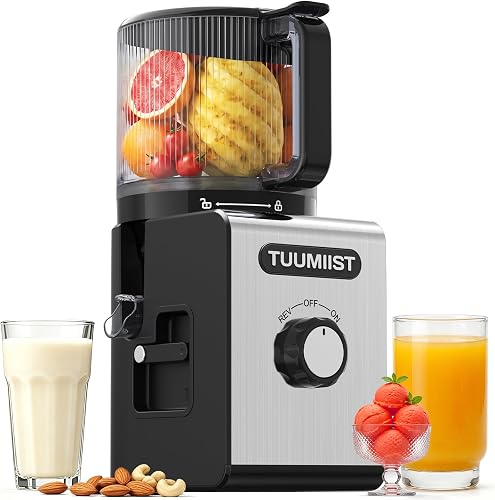
TUUMIIST 3-in-1 Juicer, 6.5-Inch: Best for quiet morning juicing
- 6.5-inch chute
- 100 fl oz hopper
- 350 W motor at 60 RPM
- Single smart strainer
A 60 RPM press keeps heat and foam low, and the single strainer means fewer parts to wash after a green juice.
Pros
- One strainer for juice, sorbet and nut milk
- Wide chute takes whole apples
- Quiet 60 RPM extraction
Cons
- Single strainer limits pulp control
TUUMIIST's 6.5-inch model suits quiet kitchens and simple routines. A 350 W motor at 60 RPM crushes greens slowly and stays quiet, so early juicing won't wake the house.
The single smart strainer handles juice, nut milk and sorbet without swapping parts, which means fewer pieces to wash after a green batch. The 6.5-inch chute takes whole apples, and the 100 fl oz hopper holds a full recipe.
The trade-off is pulp control: one strainer means you can't dial foam or fiber up or down the way you can with the Ninja. The parts are hand wash only per the care instructions.
It costs less than the Nama and presses greens well, but its motor spec is closer to the mid-range than the EanOruus. The strainer design is the part to know: no mesh to scrub, so wheatgrass and kale pulp rinses off rather than lodging in the holes.
Pick it if quiet operation and a single strainer matter more than fine pulp control. Skip it if you want dishwasher cleaning or the widest range of settings.
Godspeeds Smoothpress 6-Inch: Best for quick cleanup
- 6-inch chute
- 58 RPM slow press
- 10-year warranty
- Detachable toothed filter
Snap-apart parts rinse clean fast, which matters when leafy pulp clings to a filter after every batch.
Pros
- Detachable toothed filter rinses easily
- 10-year warranty
- Quiet under 58 dB
Cons
- 6-inch chute is narrower than 6.5-inch rivals
- Plastic build
Godspeeds Smoothpress is the cleanup pick. Leafy pulp clings to filters, and its detachable toothed filter rinses straight under the tap instead of needing a brush.
The snap-apart design comes apart without tools, so teardown takes seconds after a green juice. A 300 W motor at 58 RPM presses firmly, and Godspeeds says it extracts up to 99% juice.
The 6-inch chute is narrower than the 6.5-inch rivals, so kale and spinach need more trimming. A 10-year warranty adds confidence.
The trade-off is the plastic build and the smaller chute against the top pick. The parts list is complete out of the box: juice cup, pulp cup, pusher, cleaning brush and recipe book, so you won't hunt for a brush the first time you clean it.
Pick it if you dread scrubbing a mesh filter every morning. Skip it if you feed whole bunches and want the widest chute.
TUUMIIST Smart Touch 3-in-1: Best for touchscreen controls
- 6.5-inch chute
- Touchscreen for juice, nut milk and sorbet
- Auto-reverse
- 100 fl oz pitcher
One-tap touchscreen control and auto-reverse make this an easy pick if you want set-and-forget green juicing.
Pros
- One-tap touchscreen
- Auto-reverse clears jams
- Quiet under 60 dB
Cons
- Hand wash only per care instructions
- Touchscreen adds a part that can wear
TUUMIIST's Smart Touch model suits people who want one-tap control. A touchscreen runs juice, nut milk and sorbet, and auto-reverse clears jams without stopping to fix anything.
The 6.5-inch chute and 100 fl oz pitcher handle a large green batch, and the 350 W motor runs quietly under 60 dB. Its three-minute rinse design and quick-release parts make daily cleanup quick.
Stainless steel and BPA-free materials give the body a sturdier feel than plastic rivals. The trade-off against the EanOruus is the touchscreen: it's one more part to fail, though the machine is dishwasher safe per the care instructions.
It shares the 60 RPM speed and 3 L capacity of the non-touch TUUMIIST, so the extra money goes almost entirely to the panel and auto-reverse. Pick it if you like set-and-forget controls and big batches.
Skip it if you prefer simple dials and fewer electronics.
AAOBOSI 3-in-1 6.5-Inch: Best for beginners
- 6.5-inch chute
- 100 fl oz capacity
- Anti-clog slow masticating system
- Quiet motor
Simple three-step assembly and a big chute make this a gentle first slow juicer for green recipes.
Pros
- Easy assembly for first-time users
- Wide chute limits chopping
- Quiet motor for mornings
Cons
- Hand wash only
- No pulp filters
AAOBOSI is the easiest first slow juicer for greens. Its anti-clog slow masticating system separates pulp and juice continuously, and AAOBOSI says it handles fibrous fruits and leafy greens without interruptions.
A 6.5-inch chute means little chopping, and the 100 fl oz capacity holds multiple servings. Assembly takes three steps, and the quiet motor suits early mornings.
The trade-off is a smaller feature set than the top picks: no pulp filters, no wide range of strainers, and hand wash only. AAOBOSI also notes the machine isn't suitable for anyone under 12, so skip it in a house with young kids juicing alongside you.
Pick it if you're new to slow juicing and want a simple, roomy machine. Skip it if you want pulp control or dishwasher cleaning.
YPONE 2-in-1 5.8-Inch Juicer: Best for smaller kitchens
- 5.8-inch chute
- 55 RPM press
- Dual strainers
- Safety lock
A compact body with a 5.8-inch chute suits tighter counters, though leafy greens may need more trimming.
Pros
- Compact footprint
- Safety lock stops the motor
- Dishwasher-safe parts
Cons
- Narrowest chute here
- Dual strainers mean more parts to wash
YPONE suits small counters. Its 5.8-inch chute is the narrowest here, so leafy bunches need more cutting before they go in.
The 55 RPM press and dual 0.3 mm strainers keep juice cool and reduce clogging, and a safety lock stops the motor when the lid opens. The 400 W motor is the most powerful listed here, and the parts are dishwasher safe.
The trade-off for a compact body is prep time on greens: the narrower chute means more knife work than the 6.5-inch models. Dual strainers also cancel out some of its easy-clean pitch, since both filter layers need a rinse after a green batch.
Pick it if counter space is tight and you don't mind trimming kale. Skip it if you want to feed whole bunches.
Omega All-in-One Cold Press Juicer: Best for wheatgrass and leafy-only juicing
- Triple-stage auger
- 80 RPM slow press
- All-in-one nutrition system
- Dishwasher-safe parts
A triple-stage auger is built for leafy greens and wheatgrass, and Omega backs the motor for 15 years.
Pros
- Triple-stage auger for greens
- 15-year motor warranty
- Dishwasher-safe on top rack
Cons
- No wide chute
- Large footprint
Omega's All-in-One is built for leafy-only juicing. The triple-stage auger squeezes greens and wheatgrass in stages, and the 80 RPM low speed keeps nutrients in the glass.
Omega says the squeezing action gets high yield from minimum amounts of leafy greens and wheatgrass. The motor carries a 15-year warranty, and the parts are dishwasher safe on the top rack.
The trade-off is size and speed: it doesn't have a wide chute, and the footprint is large at 19.69 inches deep. The all-in-one name is literal: it ships with six nozzles, including four pasta nozzles and two breadstick nozzles, plus a homogenizing cone for nut butter and a sieve, so it replaces a pasta extruder as much as a juicer.
Pick it for wheatgrass and straight green juice. Skip it if you want a wide chute or fast morning batches.
How these juicers compare
Green juice quality comes down to auger speed, chute width and how the pulp is handled. This table puts the nine picks side by side on the specs that matter for leafy greens.
| Product | Best for | Chute size | Capacity | Power | Our score |
|---|---|---|---|---|---|
| EanOruus 3-in-1 Cold Press Juicer | most green juice drinkers | 6.5 in | 100 fl oz | 250 W AC brushless | 9.1 |
| Ninja NeverClog JC151 | clump-free green juice | 150 W | 8.8 | ||
| Nama J2 | hands-free big batches | 2 lb | 200 W | 8.5 | |
| TUUMIIST 3-in-1 Juicer, 6.5-Inch | quiet morning juicing | 6.5 in | 3 L | 350 W | 8.2 |
| Godspeeds Smoothpress 6-Inch | quick cleanup | 6 in | 300 W | 8.1 | |
| TUUMIIST Smart Touch 3-in-1 | touchscreen controls | 6.5 in | 3 L | 350 W | 8.0 |
| AAOBOSI 3-in-1 6.5-Inch | beginners | 6.5 in | 100 fl oz | 7.7 | |
| YPONE 2-in-1 5.8-Inch Juicer | smaller kitchens | 5.8 in | 400 W | 7.3 | |
| Omega All-in-One Cold Press Juicer | wheatgrass and leafy-only juicing | 200 W | 7.2 |
Our score weighs specs, features and buyer feedback against what you're shopping for. Speed matters most for greens: the 50 to 80 RPM presses keep heat low, while the wider 6.5-inch chutes save prep time.
Cleanup design then decides whether you'll actually juice daily.
What matters most when juicing leafy greens?
The single biggest factor is auger speed, followed by chute width. A slow press at 50 to 80 RPM crushes fibers instead of chopping them at high speed, which keeps juice cooler and yields drier pulp.
Chute width decides how much you chop before feeding.
Why slow speed beats fast spinning for greens
A centrifugal juicer spins a blade at high speed and throws pulp against a mesh. That works for carrots but whips leafy greens into foam and heats the juice.
A masticating auger turns slowly and presses the fiber, so kale and spinach release juice without as much oxidation. The EanOruus, Nama and Godspeeds all press at low speed for this reason.
How chute width changes your prep time
A 6.5-inch chute takes whole apples and large bunches, while a 5.8-inch chute needs trimming. For greens specifically, the difference shows up with bunchy kale and spinach.
If you juice every morning, the wider chute is worth it; if you juice weekly, the narrower one is fine.
Pulp control and why it matters for green juice
Green juice can turn out foamy or thick depending on the filter. Two-filter machines like the Ninja let you choose less pulp for a smoother drink.
Single-strainer models are simpler to clean but give you less say over texture.
Cleanup time you should expect
Leafy pulp clings to mesh, so a detachable filter and quick-release parts matter. Expect a few minutes for hand-wash models and less for dishwasher-safe ones.
The Godspeeds and Ninja are the easiest here to rinse.
Capacity for daily versus weekly juicing
A 100 fl oz hopper holds several days of juice for one person or a family batch. If you juice a single glass at a time, a smaller capacity is fine.
Big hoppers suit meal preppers, but they take more counter space.
Noise and how much it matters in a shared kitchen
Slow juicers are quieter than centrifugal models, but the range here is still wide enough to notice. The EanOruus uses a brushless AC motor pitched as whisper-quiet, the Nama runs at 50 RPM for quiet operation, and the TUUMIIST Smart Touch stays under 60 dB while the Godspeeds stays under 58 dB.
If you juice before anyone else is awake, or share a small apartment, a motor rated for low noise matters as much as speed. A loud machine you avoid using is worse than a slightly slower one you reach for daily.
Which leafy greens juice best in a masticating juicer?
Kale, spinach, Swiss chard and wheatgrass juice well in a slow masticating juicer. They have high water content and soft fibers that the auger can press without stalling.
Stems are the tough part, so feed them slowly or mix them with wetter produce.
Kale and spinach
Kale leaves press well when you tear them from the thick central stem. Spinach is softer and moves through quickly.
Both benefit from a low speed to keep the juice bright green instead of oxidizing brown.
Wheatgrass
Wheatgrass is the classic test for a masticating juicer. The Omega's triple-stage auger is designed for it, and the slow 80 RPM press gets a concentrated shot.
Feed it in small handfuls to avoid wrapping the auger.
Herbs and softer greens
Parsley, cilantro and lettuce press fast and need a wetter produce mixed in to keep the auger moving. A wide chute helps with bunches, and a reverse function clears any buildup.
Greens that fight the auger
Rhubarb, mature chard stems and thick broccoli stalks are the ones that slow a press down. Cut them into shorter lengths and alternate them with cucumber or apple so the auger has something watery to grip.
A machine with overheat protection, like the EanOruus and most models here, also resets on its own if a hard batch stretches a session, which saves a trip to support.
How wide a chute do you need for green juice?
A 6.5-inch chute saves the most prep time on leafy greens. It takes whole apples and large bunches with little cutting.
A 5.8 to 6-inch chute works too, but expect more trimming of kale stems and spinach bunches.
6.5-inch chutes
The EanOruus, TUUMIIST models and AAOBOSI all use a 6.5-inch feed. That width fits whole apples and large produce, so your greens go in with minimal knife work.
It's the best choice if prep time is your main frustration.
6-inch and narrower chutes
The Godspeeds uses a 6-inch chute and the YPONE a 5.8-inch one. These need more cutting, which adds a minute or two to each batch.
For occasional juicing that's fine; for daily green juice the extra prep adds up.
When the chute isn't the bottleneck
A wide chute helps only if the auger keeps up. Some leafy batches, like a tight head of kale, still need a hand pushing them down even on a 6.5-inch model.
Pair the chute width with a motor rated for fibrous produce, which is why the AC brushless and high-torque designs rank above chute size alone.
Do you need a reverse function for leafy greens?
A reverse function helps but isn't essential. It clears jams when fibrous greens wrap around the auger.
The Ninja, TUUMIIST Smart Touch and EanOruus all include one, and it saves you from taking the machine apart mid-batch.
When reverse saves you time
Kale stems and dense bunches are the usual culprits. If the auger slows or stops, reverse runs the auger backward to loosen the pulp.
On a machine without it, you stop and clear the chamber by hand.
Machines without reverse
The Godspeeds lists a reverse function, but the Nama J2 runs a single slow speed without one. Its self-feeding design reduces jams by feeding produce gradually.
If you juice leafy greens often, a reverse button is a small feature that pays off.
Which slow juicer is easiest to clean after greens?
The Godspeeds Smoothpress and Ninja NeverClog are the easiest to clean after leafy greens. Both have detachable filters and quick-release parts.
Dishwasher-safe models like the Ninja, YPONE and Omega cut cleanup further.
Hand-wash versus dishwasher models
The EanOruus, Nama and TUUMIIST 3-in-1 model are hand wash only per their care instructions. That means a few minutes at the sink after each batch.
If you juice daily, a dishwasher-safe model like the Ninja saves real time.
Keeping the filter clear
Rinse the filter right after juicing, before pulp dries. A soft brush clears mesh faster than soaking.
The Godspeeds detachable toothed filter rinses under the tap, which is the quickest of the group.
What else comes in the box
The included parts tell you how much cleanup you signed up for. The EanOruus ships with a brush, cups and a pulp filter, the Nama includes a spinning brush and two strainers, and the Godspeeds adds a recipe book.
A machine with a dedicated pulp cup, like the Ninja and both TUUMIIST models, keeps the sink free while you wash the juicer parts.
Verdict: which masticating juicer should you buy for greens?
The EanOruus 3-in-1 Cold Press Juicer is the best masticating juicer for leafy greens for most people, thanks to its wide chute, big hopper and motor built for fibrous stems. It presses kale and spinach slowly, holds a multi-day batch, and its detachable pulp outlet keeps cleanup reasonable.
Pick the Ninja NeverClog JC151 if you want pulp control and a reverse program to fight jams. Choose the Nama J2 for hands-free batches and the longest warranty.
Go with the Godspeeds for the quickest cleanup, the AAOBOSI for a simple first machine, or the Omega for wheatgrass and leafy-only juicing. For the full range of slow machines beyond greens, see our best slow masticating cold press juicer roundup.
If you want the broader field of masticating models, our masticating juicer guide covers the rest.
Our top 3 picks at a glance
-
1
Best for most green juice drinkers
EanOruus 3-in-1 Cold Press Juicer
9.1/10 our score
See it on Amazon -
2
-
3
Frequently asked questions
What makes a masticating juicer good for leafy greens?
A slow auger that crushes rather than spins keeps heat and oxidation low, and a wide chute means less chopping of kale or spinach. Look for a motor rated for fibrous stems and a filter that rinses clean without scrubbing.
Do I need to chop kale and spinach before juicing?
With a 6.5-inch chute you can feed small kale leaves and spinach bunches without much cutting. Bigger stems and tight bunches still go in faster if you tear them apart first, so keep a knife handy either way.
Will leafy greens clog a slow juicer?
Fibrous greens can build up pulp on a filter, so a reverse function and a detachable filter help. Feed greens mixed with a wetter produce like cucumber or apple to keep the auger moving and reduce clogs.
How long does green juice last in the fridge?
Cold-pressed green juice keeps best in a sealed jar in the coldest part of the fridge. Drink it within a day or two for the best flavor and color, and shake before serving since the pulp settles.
Which chute size handles the most greens?
A 6.5-inch chute takes whole apples and large bunches with less prep, while 5.8 to 6 inches needs more trimming. For leafy greens specifically, a wider chute saves the most time on bunchy kale and spinach.


